
AEO & GEO: How to Get Your Business Recommended by AI in 2026
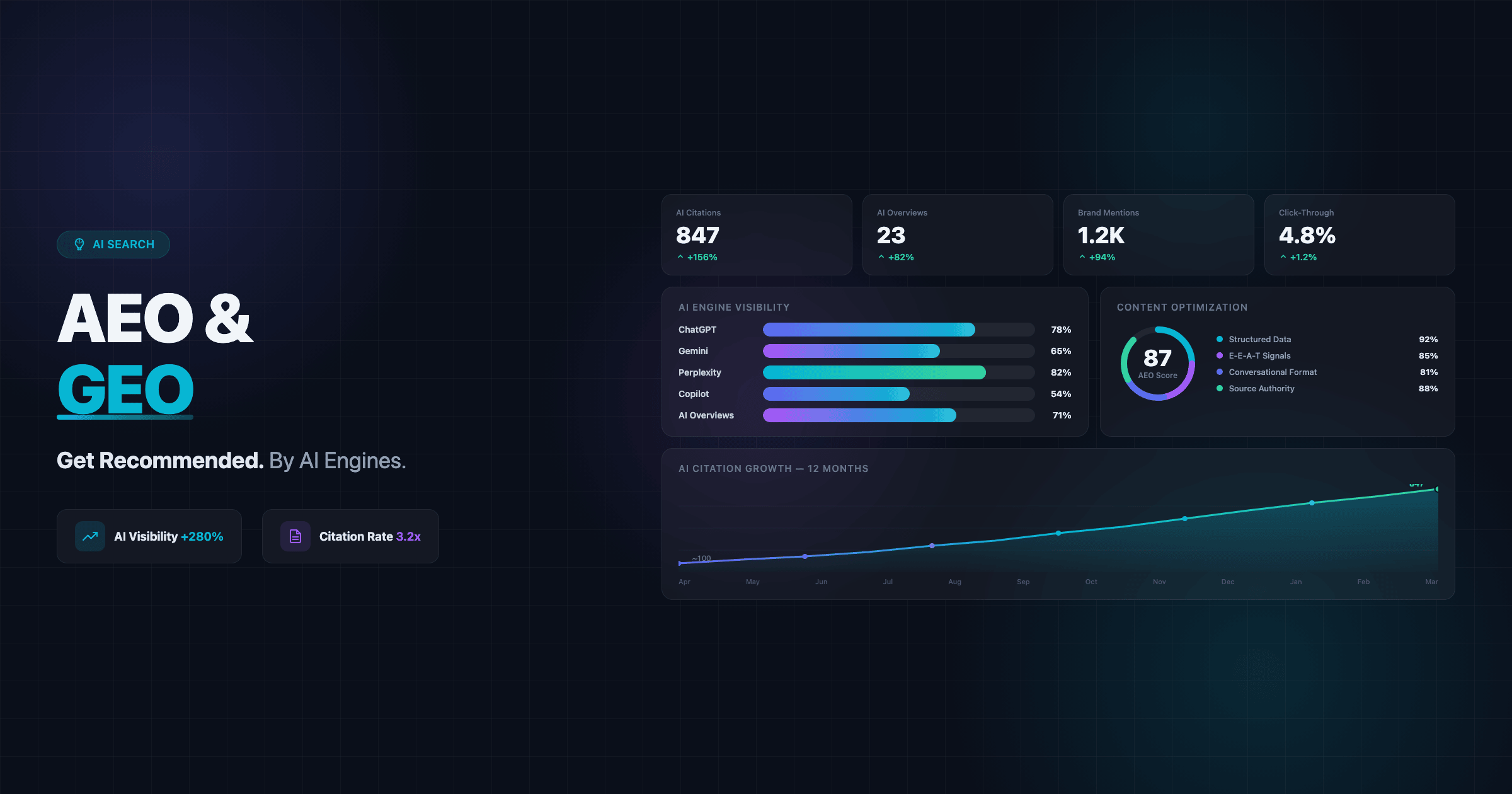
Google is no longer the only search engine that matters. In 2026, millions of people get answers from ChatGPT, Gemini, Perplexity, and Copilot — without ever clicking a traditional search result. Google itself now shows AI Overviews at the top of search results, synthesizing answers from multiple sources and often eliminating the need to visit any website at all.
This shift has created two new disciplines that every business needs to understand: AEO (Answer Engine Optimization) — optimizing your content to be selected as the source for AI-generated answers, and GEO (Generative Engine Optimization) — optimizing specifically for AI-powered search engines that generate responses rather than list links.
The businesses that adapt now will dominate. The ones that don’t will wonder why their organic traffic keeps declining despite doing “everything right” with traditional SEO. This guide covers what AEO and GEO are, how AI engines decide which sources to cite, and the specific steps you need to take to get your business recommended by AI.
The New Search Landscape: Beyond Google’s Blue Links
Traditional SEO optimizes for Google’s ranked list of blue links. That model is rapidly changing:
- Google AI Overviews — AI-generated summaries appear above all organic results for an increasing percentage of queries. Google pulls information from multiple sources and presents a synthesized answer. Your site may be cited as a source — or completely bypassed.
- ChatGPT Search — OpenAI’s search-enabled ChatGPT now handles millions of queries daily. Users ask conversational questions and receive direct answers with source citations.
- Perplexity AI — a dedicated AI search engine that provides researched answers with inline citations. It’s becoming the go-to for complex queries that traditional search handles poorly.
- Google Gemini & Microsoft Copilot — AI assistants integrated into Google and Microsoft ecosystems, answering questions by referencing web sources.
The common thread: AI engines don’t just list websites — they recommend them. When ChatGPT says “According to [Your Company], the best approach is…” that’s worth more than a page-1 ranking. It’s a direct endorsement from the AI that millions of people trust. And unlike traditional SEO, where you compete for 10 spots on page 1, AI citations can reference your content alongside any number of other sources — the barrier to entry is different.
AEO: Answer Engine Optimization
AEO focuses on making your content the preferred source when AI systems generate answers. The goal: when someone asks an AI a question related to your expertise, your content gets cited.
How AI Engines Choose Sources
AI models select sources based on several factors that overlap with — but are distinct from — traditional SEO:
- E-E-A-T signals (Experience, Expertise, Authoritativeness, Trustworthiness) — AI systems heavily weight content from recognized experts and authoritative domains. A blog post from a known industry authority will be cited over a generic article on a low-authority site.
- Structured, clear formatting — AI systems parse content more effectively when it uses clear headings, lists, tables, and direct question-answer formats. Content that buries answers in walls of text is harder for AI to extract and less likely to be cited.
- Factual accuracy and specificity — AI engines cross-reference information across multiple sources. Content with specific data, statistics, and verifiable claims gets prioritized over vague generalizations.
- Freshness — for topics where recency matters, AI engines prefer recently updated content. A guide written in 2024 will lose citations to an equivalent guide updated in 2026.
- Conversational relevance — AI engines answer conversational questions. Content that directly addresses how users actually ask questions (natural language, Q&A format) matches AI query patterns better.
AEO Optimization Tactics
- Structure content around questions — use FAQ sections, Q&A formats, and question-based H2/H3 headings. When someone asks ChatGPT “how to improve website speed,” your article with the H2 “How to Improve Website Speed” and a clear, concise answer paragraph is much more likely to be cited.
- Provide direct, concise answers — after each question heading, give a 2-3 sentence direct answer before elaborating. AI engines often extract these concise answers as citations. Think of it as writing for featured snippets — the same principle applies to AI answers.
- Include specific data and statistics — “conversion rates improve by 15-25% when…” is more citable than “conversion rates improve significantly.” AI engines prefer quantified claims they can verify across sources.
- Build topical authority — create comprehensive content clusters around your core topics. A site with 20 articles about web development will be cited as a web development source more than a site with one article. Your content marketing strategy directly feeds your AEO performance.
- Implement comprehensive schema markup — FAQ schema, HowTo schema, Article schema with author information, Organization schema. Structured data helps AI engines understand your content’s context and authority. This is also a foundational element of a proper SEO audit.
GEO: Generative Engine Optimization
While AEO is about being a cited source, GEO goes further: it’s about optimizing specifically for generative AI search engines that create synthesized responses. GEO considers how AI models process, evaluate, and present information from the web.
Key GEO Strategies
1. Optimize for conversational queries
People ask AI engines questions differently than they type into Google. Instead of “best web agency Kyiv,” they ask “Can you recommend a good web development agency in Kyiv that specializes in e-commerce?” Your content should address these longer, more specific, conversational queries naturally.
2. Create comprehensive, authoritative content
AI engines synthesize information from multiple sources. If your content covers a topic more thoroughly, more accurately, and more recently than competitors, you become the primary source. Thin content that scratches the surface won’t be cited when comprehensive guides exist on the same topic.
3. Establish clear entity identity
AI engines understand entities — brands, people, organizations. Strengthen your entity identity by: maintaining consistent brand mentions across the web, having a complete Google Business Profile (local SEO matters here), building quality backlinks from authoritative sources in your niche (link building directly feeds GEO), and ensuring your brand appears in industry directories and publications.
4. Create an llms.txt file
Just as robots.txt tells traditional crawlers how to interact with your site, llms.txt is an emerging standard that helps AI systems understand your site’s structure, key content, and what information is most important. Include a clear description of your business, links to your most important content, and structured information about your services and expertise.
5. Build a strong citation profile
AI engines verify information by cross-referencing sources. If your brand, statistics, or insights are mentioned across multiple authoritative sites, AI engines gain confidence in citing you. This is where digital PR, guest posting, and industry participation create a direct GEO advantage.
The llms.txt Standard: Your AI-Readable Resume
The llms.txt file is one of the most impactful — and most overlooked — GEO tactics. Placed at your site’s root (/llms.txt), it provides AI crawlers with a structured summary of your site that’s easy for language models to process.
What to include in your llms.txt:
- Company description — who you are, what you do, what makes you unique. Write it in clear, factual prose that an AI can directly reference.
- Core services — list your main services with brief descriptions. Be specific about your expertise areas.
- Key content links — link to your most important and authoritative content. This signals to AI engines which pages represent your expertise best.
- Team expertise — mention key team members and their qualifications. E-E-A-T signals matter for AI source selection.
- Contact information — make it easy for AI systems to include your contact details in recommendations.
Most businesses don’t have an llms.txt file yet. Adding one now gives you a significant early-mover advantage as AI engines increasingly reference this standard.
Practical AEO/GEO Checklist
Here’s what to implement on your site today:
- Add FAQ schema to key pages — every service page and important blog post should have structured FAQ content. This is the single most impactful AEO action.
- Create an llms.txt file — write a clear, structured summary of your business for AI crawlers.
- Audit your content for direct answers — does your content directly answer common industry questions? Add concise answer paragraphs after question headings.
- Strengthen E-E-A-T signals — add author bios with credentials, link to industry publications you’ve been featured in, display certifications and awards.
- Update existing content — refresh dates, add new data, ensure accuracy. AI engines deprioritize outdated content.
- Build topical content clusters — create comprehensive coverage of your core topics with interlinked articles.
- Implement complete schema markup — Organization, LocalBusiness, Article, FAQ, HowTo, Product — whatever applies to your content type.
- Monitor AI citations — regularly search for your brand in ChatGPT, Perplexity, and Gemini to see where and how you’re being cited.
- Optimize robots.txt for AI crawlers — ensure GPTBot, ClaudeBot, PerplexityBot, and other AI crawlers can access your content (unless you specifically want to block them).
- Track AI Overviews appearances — monitor Google Search Console for queries where your site appears in AI Overview citations.
AEO/GEO vs. Traditional SEO: How They Work Together
AEO and GEO don’t replace traditional SEO — they build on it. The foundation remains the same: technically sound website, quality content, strong backlink profile, good user experience. Everything you do for traditional website promotion still matters.
But AEO/GEO adds a new layer:
- Traditional SEO: rank in Google’s organic results → user clicks → visits your site
- AEO/GEO: be cited in AI answers → user sees your brand as a recommended source → visits your site OR builds trust that converts later
The businesses that win in 2026 optimize for both channels simultaneously. Every piece of content should be optimized for traditional search AND structured for AI citation. This isn’t double the work — it’s about 20% additional effort on top of solid SEO practices.
Common AEO/GEO Mistakes
- Blocking AI crawlers — some businesses block GPTBot and other AI crawlers in robots.txt, thinking this protects their content. In reality, it just ensures they’re never cited while competitors are. Unless you have specific intellectual property concerns, allow AI crawlers access.
- Ignoring structured data — schema markup is optional for traditional SEO but increasingly essential for AI citation. Sites without structured data are harder for AI engines to parse and less likely to be selected as sources.
- Writing only for keywords, not questions — traditional SEO targets keywords. AEO targets questions. If your content doesn’t directly answer the questions your audience asks, AI engines will cite someone else’s content that does.
- Neglecting brand entity signals — if AI engines can’t confidently identify your brand as an authority in your niche, they won’t recommend you. Consistent brand presence across the web — social profiles, industry directories, guest posts, social media, and press mentions — builds the entity signals AI engines need.
- Not monitoring AI mentions — you can’t improve what you don’t measure. Regularly check how AI engines reference your brand and competitors to identify gaps and opportunities.
How EffectLab Gets Your Business Recommended by AI
AEO and GEO are core components of every website we build. Here’s what we implement from day one:
- Complete schema markup ecosystem — Organization, LocalBusiness, Article, FAQ, HowTo, and BreadcrumbList schemas configured to maximize AI comprehension of your content and authority.
- llms.txt setup and optimization — a structured, AI-optimized summary of your business that tells AI crawlers exactly what you do, what you’re expert in, and where to find your best content.
- AI-optimized content architecture — we structure content with direct question-answer formats, clear headings, and concise summary paragraphs that AI engines prefer to cite.
- E-E-A-T signal implementation — author bios, credential displays, case study showcases, and trust signals that strengthen your authority in AI evaluations.
- AI crawler access optimization — robots.txt configured to allow responsible AI crawlers, with proper directives for content that should and shouldn’t be indexed.
- Ongoing AI visibility monitoring — we track how your brand appears in ChatGPT, Gemini, Perplexity, and Google AI Overviews, identifying opportunities to increase citation frequency.
We also build websites with the technical foundation that AI engines trust: fast loading speeds, clean code architecture, proper analytics tracking, mobile-first design, and high-conversion elements that turn AI-referred visitors into customers.
Want your business to be the one AI recommends? Contact us — we’ll audit your current AI visibility, identify the biggest opportunities, and build a strategy that puts your brand at the center of AI-generated answers in your industry.
Conclusion
The shift from “search and click” to “ask and answer” is the biggest change in search since Google launched. Businesses that optimize for AI engines now — through AEO and GEO strategies — will have a massive competitive advantage as this transition accelerates.
The good news: most of your competitors haven’t started. The fundamentals overlap heavily with good SEO — structured content, topical authority, E-E-A-T signals, and quality backlinks. Add an llms.txt file, implement FAQ schema across your site, structure your content to directly answer questions, and monitor your AI visibility monthly.
The question isn’t whether AI will change how your customers find you — it already has. The question is whether you’ll be the business AI recommends, or the business it overlooks.