
Where AI Recommends Local Businesses: How to Get Found by ChatGPT, Gemini, and Perplexity
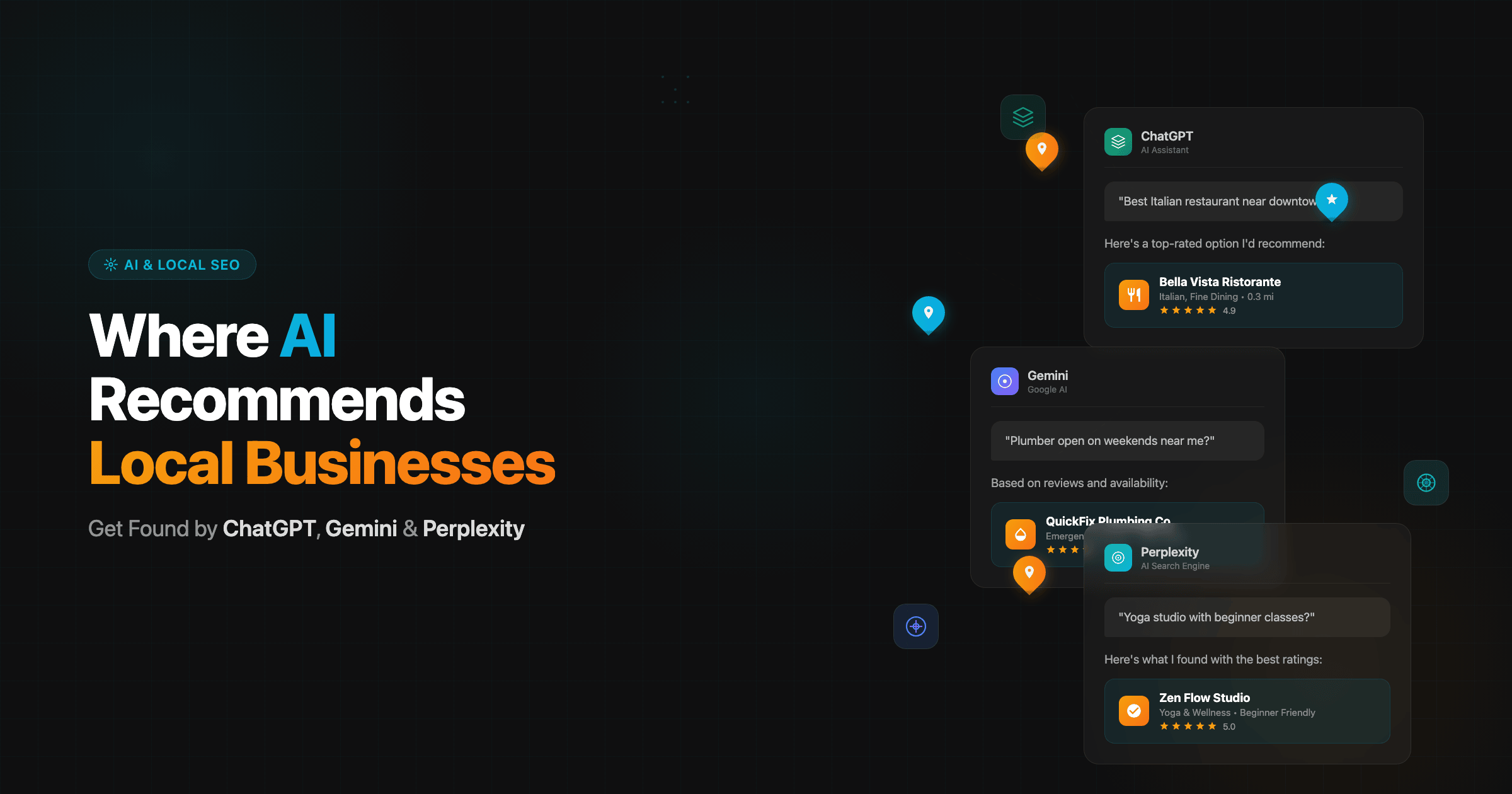
Your next customer might never type your business name into Google. Instead, they’ll ask ChatGPT “What’s the best Italian restaurant near downtown?” or tell Gemini “Find me a reliable plumber in Brooklyn.” And the AI will recommend specific businesses — yours or your competitor’s.
This is the new reality of local discovery. AI assistants are becoming the first point of contact between consumers and local businesses. The question isn’t whether AI will recommend local businesses — it already does. The question is whether your business is one of them.
In this guide, we’ll map exactly which AI systems recommend local businesses, how they decide which businesses to feature, and the specific steps you can take to get your business into AI-generated recommendations.
The AI Systems That Recommend Local Businesses
Not all AI platforms treat local business recommendations the same way. Each has different data sources, ranking logic, and recommendation patterns. Understanding these differences is critical for your optimization strategy.
ChatGPT (OpenAI)
ChatGPT now handles local queries with increasing sophistication. When users ask for business recommendations, ChatGPT draws from its training data, web browsing capabilities, and integrated search. It tends to recommend businesses that have strong web presence, consistent mentions across authoritative sources, and clear descriptions of services and locations. ChatGPT often cites review platforms, business directories, and niche guides when forming recommendations.
What influences ChatGPT recommendations: authoritative mentions on review sites and directories, well-structured website content, consistent NAP (Name, Address, Phone) data across the web, and presence in curated lists and guides.
Google Gemini & AI Overviews
Google’s AI is the most powerful player in local recommendations because it has direct access to Google Business Profile data, Google Maps, and the entire Google search index. When Gemini answers a local query, it pulls from Google Maps reviews, GBP listings, local search results, and website content. Google AI Overviews — the AI-generated summaries at the top of search results — increasingly feature local businesses for geo-intent queries.
What influences Gemini recommendations: Google Business Profile optimization, review quantity and quality, local SEO signals, website authority, proximity to the searcher, and structured data markup.
Perplexity AI
Perplexity is an AI-powered search engine that provides sourced answers with citations. For local queries, it searches the web in real-time, pulling from review sites, business directories, local blogs, and news sources. Perplexity always shows its sources, making it transparent which websites influenced the recommendation. This means getting mentioned on authoritative local sources directly translates to Perplexity visibility.
What influences Perplexity recommendations: mentions on high-authority websites, Yelp/TripAdvisor/niche directory presence, local press coverage, and comprehensive website content with clear location information.
Microsoft Copilot (Bing AI)
Microsoft Copilot uses Bing’s search index and Bing Places for Business listings. It’s integrated into Windows, Edge, and Microsoft 365. When users ask Copilot for local recommendations, it draws from Bing Maps, Bing Places, and web search results. Businesses that are optimized for Bing — including having a Bing Places listing — get an advantage here.
What influences Copilot recommendations: Bing Places for Business listing, Bing search optimization, LinkedIn presence (Microsoft-owned), website authority in Bing’s index, and review signals.
Apple Intelligence & Siri
Apple Intelligence powers Siri’s local recommendations on iPhone, iPad, Mac, and HomePod. Apple uses Apple Maps data, Yelp integration, and its own web search (powered by Apple’s search engine with Google as fallback). With Apple Intelligence expanding in 2026, Siri is becoming more conversational about local recommendations, especially for hands-free queries.
What influences Apple/Siri recommendations: Apple Maps listing (via Apple Business Connect), Yelp reviews, website mobile optimization, and Apple Maps ratings.
Why AI Recommends Certain Businesses Over Others
AI systems don’t randomly pick businesses. They evaluate signals that indicate trustworthiness, relevance, and quality. Understanding these signals is the foundation of getting recommended.
- Consistent identity across the web — your business name, address, phone number, and description should be identical everywhere. AI systems cross-reference multiple sources. Inconsistencies create doubt.
- Reviews and reputation signals — quantity, recency, quality, and sentiment of reviews across Google, Yelp, TripAdvisor, and industry platforms. AI systems aggregate these signals to assess trustworthiness.
- Authoritative mentions — being mentioned in local news, industry publications, curated lists, and respected directories. AI treats these as third-party validation.
- Structured, clear website content — your website should clearly state what you do, where you’re located, who you serve, and why you’re different. AI systems parse website content to understand your business.
- Entity recognition — AI systems build “knowledge graphs” of entities (businesses, people, places). Businesses with strong entity signals — consistent branding, Wikipedia mentions, structured data — are easier for AI to identify and recommend confidently.
Actionable Steps to Get Your Business Recommended by AI
1. Claim and Optimize Every Platform Listing
Each AI system has preferred data sources. Cover them all:
- Google Business Profile — the single most important listing. Complete every field, add photos monthly, post updates weekly, and respond to every review. This feeds both Google Gemini and Google AI Overviews. Follow our complete local SEO guide for detailed optimization steps.
- Bing Places for Business — directly feeds Microsoft Copilot. Often overlooked but takes 15 minutes to set up.
- Apple Business Connect — feeds Siri and Apple Intelligence. Claim your listing at business.apple.com.
- Yelp Business Page — feeds both Siri/Apple and Perplexity. Keep it updated with photos, business hours, and respond to reviews.
- Industry-specific directories — TripAdvisor (hospitality), Houzz (home services), Avvo (legal), Healthgrades (medical). AI systems use these niche sources for industry-specific queries.
2. Build Your Website as an AI-Readable Knowledge Base
Your website is the primary source AI systems use to understand your business. Structure it for AI comprehension:
- Clear service pages — dedicate a page to each major service. Include what the service is, who it’s for, your service area, and what makes you different. Don’t bury this information in PDFs or image-only content.
- Location-specific pages — if you serve multiple areas, create dedicated pages for each. “Plumbing Services in Brooklyn” is more AI-parseable than a single page listing 20 neighborhoods.
- FAQ sections — add FAQ content that mirrors how people ask AI assistants questions. “What’s the best bakery in [city]?” → your FAQ answers “Why customers choose [Your Bakery] in [city].” This directly feeds AEO and GEO optimization.
- About page with entity signals — include founding year, founders, awards, certifications, and partnerships. This helps AI systems build a strong entity profile for your business.
- llms.txt file — add a structured file at your domain root that helps AI language models understand your business. This is an emerging standard that gives you a direct communication channel with AI crawlers.
3. Implement Structured Data (Schema Markup)
Schema markup is how you speak AI’s native language. For local businesses, implement:
- LocalBusiness schema — with name, address, phone, business hours, geo coordinates, price range, and payment methods
- Review/AggregateRating schema — if you display reviews on your site
- FAQ schema — for FAQ sections on your pages
- Service schema — for each service you offer, with description and service area
- BreadcrumbList schema — helps AI understand your site structure
Structured data doesn’t guarantee AI recommendation, but it makes it significantly easier for AI systems to parse and trust your information. It’s a foundational element of modern website promotion.
4. Generate Reviews Strategically
Reviews are the strongest trust signal for AI recommendation engines. But it’s not just about Google reviews anymore:
- Diversify review platforms — Google, Yelp, Facebook, TripAdvisor, and industry-specific sites. AI systems cross-reference multiple platforms.
- Encourage detailed reviews — “Great service!” tells AI nothing. “Best Italian restaurant in downtown Portland — their handmade pasta and wine selection are outstanding” gives AI specific data points to reference in recommendations.
- Respond to every review — your responses are indexed by AI. A thoughtful response to a negative review can actually improve your AI visibility by showing professionalism.
- Maintain review recency — a business with 200 reviews from 2023 and none from 2026 looks abandoned. AI systems weight recency heavily.
5. Get Mentioned on Authoritative Sources
AI systems trust third-party validation. Being mentioned on authoritative websites directly influences whether AI recommends you:
- Local press and blogs — reach out to local journalists, bloggers, and community websites. A mention in “Best Coffee Shops in Austin” on a local blog feeds AI recommendations.
- Industry publications — trade magazines, industry association websites, and professional directories.
- “Best of” lists and curated guides — AI systems heavily reference list-format content. Getting included in “Top 10 [your service] in [your city]” articles is high-impact. This connects to broader link building strategies.
- Wikipedia and Wikidata — if your business is notable enough, a Wikipedia mention is the ultimate entity signal. Wikidata entries feed directly into AI knowledge graphs.
6. Create Content That Answers Local AI Queries
Think about what people ask AI about local businesses and create content that answers those questions:
- “What’s the best [service] in [city]?” → Create content that positions you as the answer
- “How much does [service] cost in [city]?” → Publish transparent pricing guides
- “[Service] near me open now” → Ensure your hours are accurate everywhere
- “[Service] vs [alternative] in [city]” → Create comparison content
This content strategy feeds both AI systems and traditional SEO. It’s the intersection of content marketing and AI visibility that drives real local business growth.
Common Mistakes That Keep Your Business Out of AI Recommendations
- Inconsistent business information — different phone numbers, addresses, or business names across platforms confuse AI systems. Audit everything with tools like Moz Local or BrightLocal.
- Relying on Google alone — Google Business Profile is essential, but AI systems like Perplexity and ChatGPT pull from many sources. A Google-only strategy misses 40-60% of AI touchpoints.
- No website content beyond a homepage — a one-page website gives AI almost nothing to work with. Service pages, location pages, blog content, and FAQs all provide AI with ammunition to recommend you.
- Ignoring non-Google review platforms — Yelp reviews feed Apple/Siri, TripAdvisor feeds Perplexity, Facebook reviews add social proof signals. Diversify your review presence.
- Treating AI optimization as separate from SEO — it’s not. The fundamentals are the same: quality content, technical excellence, authority signals, and user trust. AI optimization adds a layer on top of solid SEO foundations. Avoid the common website mistakes that hurt both SEO and AI visibility.
How to Monitor Your AI Visibility
Tracking AI recommendations isn’t as straightforward as checking Google rankings, but it’s possible:
- Manual testing — monthly, ask each major AI system (ChatGPT, Gemini, Perplexity, Copilot) your key queries. Document which businesses they recommend and whether yours appears.
- Google Search Console — monitor queries where your site appears in AI Overviews (Google is gradually adding this data).
- Brand monitoring tools — set up alerts for your business name mentions across the web. New mentions = new potential AI data sources.
- Review monitoring — track review velocity and sentiment across all platforms monthly. Use analytics tools to connect the dots between AI visibility and actual business results.
How EffectLab Helps Local Businesses Get Found by AI
We help local businesses build comprehensive AI visibility through:
- Multi-platform listing optimization — Google Business Profile, Bing Places, Apple Business Connect, and industry directories — all configured and optimized for AI discoverability.
- AI-optimized website development — we build websites with structured data, llms.txt files, FAQ schemas, and content architecture specifically designed for both traditional search and AI recommendation engines.
- Local content strategy — service pages, location pages, and blog content structured to answer the exact queries people ask AI assistants about your industry.
- Review strategy and monitoring — systems for generating reviews across multiple platforms and monitoring your AI visibility monthly.
Want to find out if AI systems are already recommending your competitors instead of you? Contact us for a free AI visibility audit — we’ll check every major AI platform and show you exactly where you stand and what to fix.
Conclusion
AI-powered discovery is no longer experimental — it’s how a growing percentage of consumers find local businesses. ChatGPT, Gemini, Perplexity, Copilot, and Siri are all recommending local businesses right now. The businesses that show up in these recommendations aren’t lucky — they’ve built strong signals across multiple platforms.
Start with the fundamentals: claim your listings everywhere, optimize your Google Business Profile, make your website AI-readable with structured data, generate reviews across multiple platforms, and get mentioned on authoritative local sources. These steps don’t just improve your AI visibility — they strengthen your entire digital presence.
The businesses that act now will have a significant advantage as AI-powered search becomes the default. Don’t wait for your competitors to claim the AI recommendations that should be yours.