
Branding in the AI Era: How to Stand Out When Everyone Uses the Same Tools
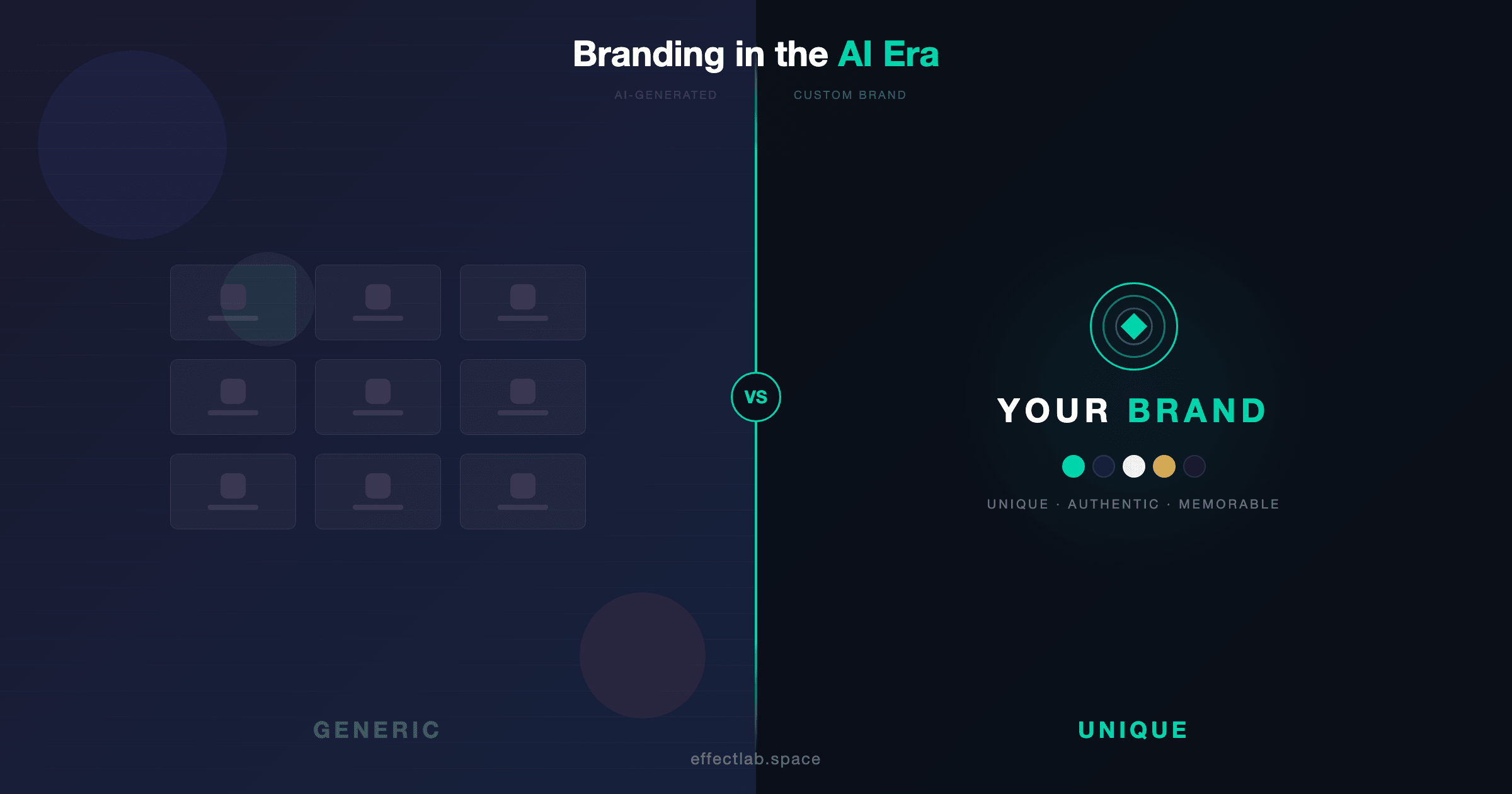
In 2025, AI tools generated over 15 billion pieces of content — blog posts, social media graphics, website copy, even brand logos. The output was staggering, but something unexpected happened: everything started looking the same. The same hero sections, the same gradient backgrounds, the same corporate-speak paragraphs. A paradox emerged that’s now reshaping how businesses think about marketing: the more AI content floods the internet, the more valuable a genuine, distinctive brand becomes.
This isn’t a hot take — it’s a structural shift. When every competitor can generate “professional” content in minutes, the content itself stops being a differentiator. What separates winners from the noise is something AI can assist with but never replace: brand identity. Here’s how to build one that no algorithm can copy.
The AI Sameness Problem
Open ten websites in the same industry built in 2025-2026. Count how many feature a dark gradient hero with floating geometric shapes, a sans-serif headline promising to “transform” or “revolutionize” something, and an AI-generated illustration of a suspiciously perfect person. You’ll find at least seven.
This phenomenon has a name: AI slop — a term that gained traction in 2025 to describe the flood of mediocre, undifferentiated AI-generated content. It’s not that AI produces bad output. The problem is that it produces average output at scale. Every tool draws from the same training data, optimizes for the same engagement metrics, and converges on the same “best practices.”
The data confirms what users already feel. A 2025 survey by Salesforce found that 67% of consumers can identify AI-generated content, and 52% say they trust it less than human-created content. A separate study by Edelman showed that brand trust dropped 8 points globally among companies perceived as relying heavily on AI for customer-facing communication.
The result? A race to the bottom where everyone looks professional but nobody looks memorable. And in a market where attention is the scarcest resource, blending in is the most expensive mistake you can make. We covered several costly website mistakes before — inconsistent or generic branding is now at the top of the list.
Why Brand Identity Matters More Than Ever
Brand identity is the sum of visual, verbal, and experiential elements that make a business recognizable and distinct. It’s your logo, your color palette, the way you write emails, the feeling someone gets when they visit your site. And in the AI era, it’s your competitive moat.
McKinsey’s 2025 B2B Pulse Survey found that companies with strong, consistent brand identities grow revenue 33% faster than competitors with weak or inconsistent branding. Interbrand’s annual ranking shows that the top 100 global brands increased their combined value by $3.3 trillion over the past decade — not because they made better products (many competitors match them on features), but because they built emotional connections that resist substitution.
Consider Apple. You can recognize an Apple ad with the sound off and the logo hidden. That’s not design — it’s decades of deliberate brand building. Or Patagonia, whose brand is so aligned with environmental values that customers pay premium prices and become evangelists. No AI prompt can generate that kind of loyalty.
The principle applies equally to small and mid-size businesses. A local architecture firm with a distinctive brand voice and consistent visual language will win projects over a competitor with a generic AI-generated website — even if the generic site is technically “prettier.” Clients buy trust, and trust is built through recognition.
The 5 Pillars of AI-Proof Branding
Building a brand that withstands the AI content flood requires attention to five interconnected elements. Skip one, and the others weaken.
1. Visual Identity — your logo, color system, typography, and imagery guidelines. These aren’t decorations; they’re recognition triggers. Every time someone sees your brand’s unique shade of blue or your custom typeface, neural pathways fire that connect to their previous experiences with you.
2. Brand Voice & Tone — the personality expressed through words. Are you formal or casual? Technical or accessible? Witty or straight-shooting? This must be consistent across every touchpoint — website, emails, social media, customer support.
3. Brand Story & Origin — why your business exists beyond making money. Authentic stories create emotional connection. A founder’s personal frustration that sparked the company, a pivotal moment that shaped its values, or a genuine mission that drives decisions.
4. Customer Experience — every interaction is branding. How fast you respond to inquiries, how your invoices look, the onboarding process, the thank-you email after a project. These micro-moments accumulate into brand perception.
5. Values & Position — what you stand for and, equally important, what you stand against. In a world of AI-generated neutrality, having a clear position on industry issues signals authenticity and attracts aligned customers.
Visual Identity: Beyond AI-Generated Logos
AI logo generators have become impressively capable. For $0, you can get a decent logo in 30 seconds. But “decent” is exactly the problem. Run the same prompt through Midjourney, DALL-E, and Stable Diffusion, and you’ll get outputs that share uncanny similarities — the same geometric minimalism, the same lettermark treatments, the same gradient choices.
A custom-designed logo costs between $2,000 and $15,000, and there’s a reason. Professional brand designers don’t just create pretty shapes — they embed meaning, ensure scalability across every medium (business cards to billboards), and deliver something legally protectable. You cannot trademark an AI-generated image in most jurisdictions. That means your AI logo offers zero intellectual property protection — any competitor can generate something nearly identical.
Visual identity extends far beyond the logo. It includes a defined color palette (primary, secondary, and accent colors with specific hex values), typography pairings (headline and body fonts that reflect brand personality), photography or illustration style, icon systems, and layout principles. These elements working together create what designers call a visual language — a system so consistent that audiences recognize your brand even without seeing the logo.
When we developed the visual identity for WohnArt Studio, every design decision — from the muted, sophisticated color palette to the elegant serif typography — was crafted to communicate one thing: timeless quality. For Zlata Consola, the approach was entirely different: warm gold tones and premium textures that reflected the brand’s artisanal craftsmanship. Same design team, completely different outcomes — because each brand demanded its own visual language. That’s something a one-size-fits-all AI tool simply cannot replicate.
Brand Voice: How to Sound Like No One Else
If your website copy could be swapped with a competitor’s and nobody would notice, you have a voice problem. Brand voice is the personality behind the words — and it’s one of the hardest things for AI to authentically create.
Consider the spectrum. Mailchimp sounds playful and slightly irreverent (“High fives! Your campaign is on its way.”). Stripe sounds technically precise and quietly confident (“Build and scale your payments infrastructure”). Duolingo has embraced controlled chaos on social media, turning a green owl into a pop culture icon. Each voice is instantly recognizable because it’s specific.
Building your own brand voice starts with three questions: (1) If your brand were a person, how would they talk at a dinner party? (2) What three adjectives should every piece of content embody? (3) What words or phrases would your brand never use?
Document these answers in a brand voice guide. Include do/don’t examples for different content types — website copy, social posts, emails, error messages. This guide becomes the reference point for every team member and every AI tool you use for content assistance. The irony is that AI becomes more useful once you have a defined voice — you can prompt it to write in your voice rather than defaulting to generic corporate tone.
The key distinction: AI can mimic a voice once defined, but it cannot originate an authentic one. The voice must come from human insight about who the brand truly is.
Content Strategy: Human Touch in an AI World
Google’s E-E-A-T framework (Experience, Expertise, Authoritativeness, Trustworthiness) isn’t just an SEO consideration — it’s a branding imperative. Google is explicitly prioritizing content that demonstrates first-hand experience and genuine expertise. As we detailed in our website promotion guide, AI-generated content without human expertise signals is increasingly penalized.
The smart approach to content in 2026 follows an 80/20 rule: let AI handle research, data compilation, first drafts, and formatting (the 80% that’s mechanical), while humans contribute strategy, original opinions, personal experience, and storytelling (the 20% that builds brand). A blog post that shares a genuine lesson from a failed project is infinitely more valuable than a perfectly structured AI article with no original insight.
This principle extends to visual content. Custom-developed solutions always outperform template-based or AI-generated alternatives when it comes to brand consistency. A high-converting landing page isn’t just about following best practices — it’s about expressing your brand’s unique value proposition through design and copy that feel unmistakably yours.
Content volume has become meaningless. A single well-researched, experience-backed article will outperform fifty AI-generated pieces in both search rankings and brand building. Focus on creating content only you can create — analysis from your specific perspective, case studies from your actual work, opinions formed through genuine expertise.
Measuring Brand Strength
Branding often gets dismissed as “soft” because executives struggle to measure it. But brand strength is quantifiable — you just need the right metrics.
Direct traffic — visitors who type your URL directly. This is the purest measure of brand awareness. If your direct traffic is growing, people remember you.
Branded search volume — how often people Google your brand name. Use Google Search Console or tools like Ahrefs to track this. Rising branded searches mean rising brand awareness.
Share of voice (SOV) — your brand’s visibility compared to competitors across channels. Tools like Brandwatch, Semrush, and Sprout Social can quantify this. Research consistently shows that brands whose SOV exceeds their market share tend to grow.
Net Promoter Score (NPS) — a simple survey: “How likely are you to recommend us to a friend?” Scores above 50 indicate strong brand loyalty. Below 20 signals a brand problem.
Social mentions and sentiment — track what people say about you unprompted. Tools like Brand24, Mention, or even Google Alerts provide a real-time pulse on brand perception.
Set benchmarks for each metric and review quarterly. Brand building is a compounding investment — the returns aren’t instant, but they accelerate over time and create increasingly durable competitive advantages.
How EffectLab Approaches Branding
At EffectLab, we believe branding should be as unique as the business it represents. That’s why we create custom brand identities from scratch — no AI-generated logos, no template-based design systems, no copy-paste visual languages.
For WohnArt Studio, we developed an elegant, minimalist identity that reflects the sophistication of high-end interior design. The muted palette and refined typography communicate quality before a single word is read. For Zlata Consola, the brand needed to convey artisanal craftsmanship and premium positioning — so we built a visual system around warm golds and rich textures that feel handcrafted, not machine-generated.
When Zoria 2 residential complex needed a modern brand identity, we created a clean, contemporary visual system that balanced architectural precision with warmth and livability — qualities that matter to homebuyers and that no AI could intuit from a text prompt.
Every project starts with understanding the business — its values, its audience, its competitive landscape — and translates that understanding into a visual and verbal identity that cannot be replicated by typing a prompt into an AI tool. If you’re ready to build a brand that stands the test of the AI era, let’s talk.
Conclusion: Your Brand Is Your Moat
AI is the most powerful business tool to emerge in decades. Use it for research, automation, prototyping, and efficiency gains. But don’t outsource the one thing that makes your business irreplaceable: your brand.
In an ocean of AI-generated sameness, a distinctive brand is a lighthouse. It signals quality, builds trust, commands premium pricing, and creates the kind of emotional loyalty that no algorithm can manufacture. The businesses that will thrive in the AI era aren’t those using the most advanced tools — they’re those with the strongest identities.
Invest in custom design. Develop a unique voice. Tell your authentic story. Build experiences that reflect your values. These aren’t nostalgic luxuries — they’re strategic necessities. Because AI can copy everything about your business except the one thing that matters most: who you are.