
E-Commerce in 2026: 8 Trends Defining Online Sales
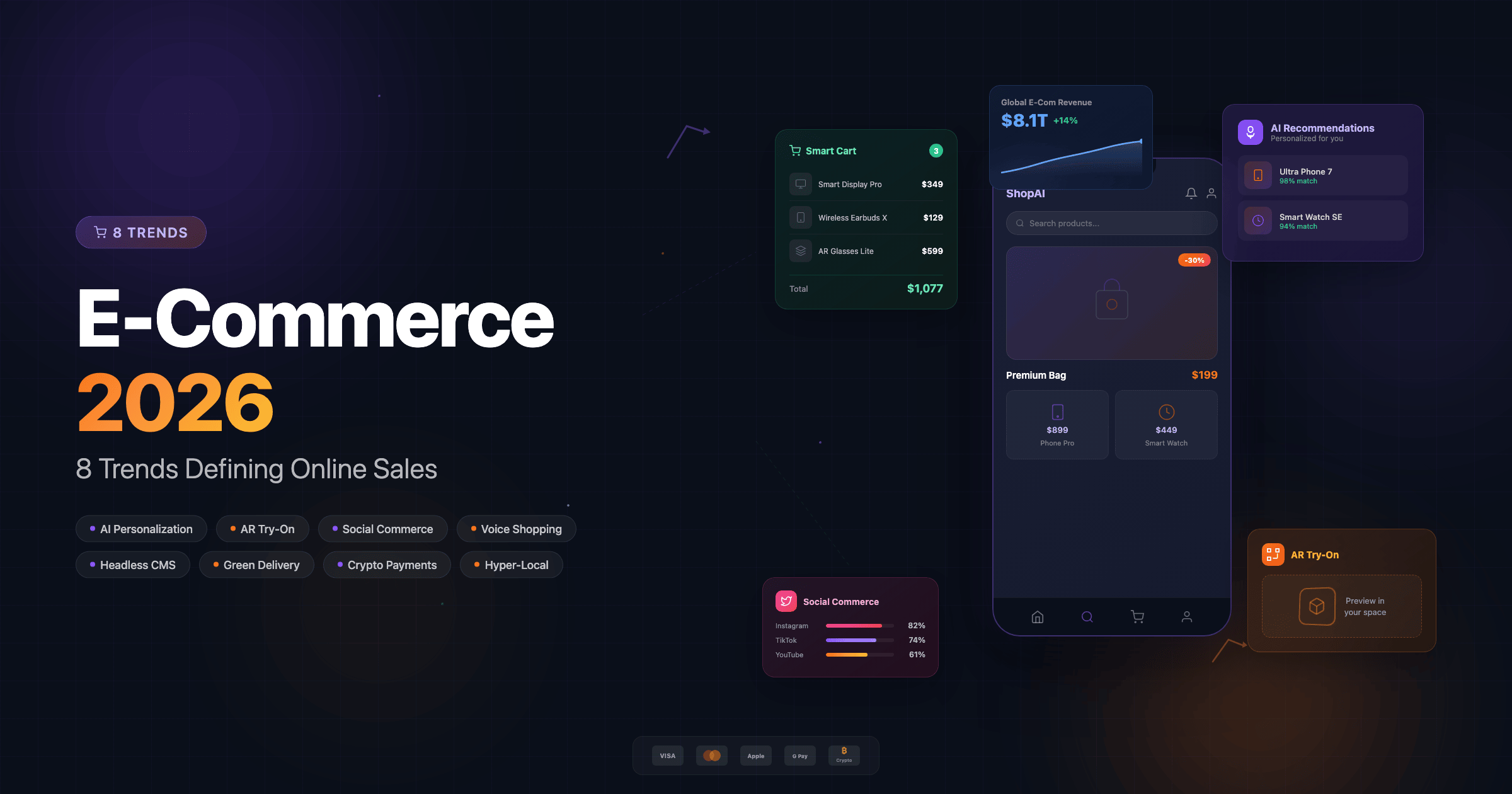
Global e-commerce sales are projected to surpass $7.5 trillion in 2026. But the way people shop online is changing faster than most businesses can adapt. The strategies that drove growth in 2023 — basic product pages, standard checkout flows, generic email blasts — are now table stakes at best and conversion killers at worst.
The stores winning in 2026 aren’t just selling products online. They’re building AI-powered shopping experiences, letting customers try products in augmented reality, selling directly through social media feeds, and personalizing every touchpoint based on real-time behavior data.
This article breaks down the 8 e-commerce trends that are actually reshaping online sales right now — not vague predictions, but concrete shifts you can act on. For each trend, we cover what’s happening, why it matters, and how to implement it in your store.
1. AI-Powered Personalization at Scale
Personalization isn’t new, but AI has transformed it from “Hey [First Name]” emails into real-time, behavior-driven experiences across every touchpoint. In 2026, the most successful e-commerce stores dynamically adjust product recommendations, homepage layouts, search results, pricing displays, and even navigation based on each visitor’s browsing history, purchase patterns, and real-time behavior.
The numbers are compelling: personalized product recommendations drive 10-30% of e-commerce revenue. Stores with AI-driven personalization see 20% higher average order values. And the technology is no longer exclusive to Amazon-sized budgets — platforms like Shopify, WooCommerce, and headless commerce solutions now integrate with AI personalization tools like Dynamic Yield, Nosto, or Clerk.io at accessible price points.
How to implement: Start with product recommendations on product pages and cart (“customers also bought”). Add personalized email flows triggered by browse behavior. Then graduate to dynamic homepage content and personalized search results. The key is having clean product data and proper event tracking — without good data, even the best AI delivers poor results.
2. Augmented Reality Shopping Experiences
AR in e-commerce has moved from gimmick to genuine conversion driver. Furniture retailers report 40% fewer returns when customers use AR placement tools. Beauty brands see 2.5x higher conversion rates with virtual try-on features. And with Apple Vision Pro, Meta Quest, and WebXR pushing the technology forward, AR shopping is becoming an expectation, not a novelty.
The most practical AR applications in 2026:
- Virtual try-on — cosmetics, eyewear, jewelry, clothing. Customers see products on themselves before buying.
- Space visualization — furniture, decor, appliances. Place a 3D product model in your actual room using your phone camera.
- Product interaction — electronics, packaging, luxury goods. Rotate, zoom, and examine products in 3D detail that flat photos can’t match.
- Size and fit tools — AI-powered body measurement combined with AR preview reduces the #1 reason for clothing returns: wrong size.
How to implement: For most stores, start with 3D product photography using tools like Shopify’s built-in 3D viewer or third-party solutions like Threekit. If you sell furniture or home goods, integrate with AR.js or model-viewer for web-based AR (no app required). For fashion, explore virtual try-on APIs from companies like Vue.ai or Zeekit.
3. Headless Commerce Architecture
Headless commerce — decoupling the frontend presentation layer from the backend e-commerce engine — has gone from buzzword to standard architecture for growth-focused stores. The reason is simple: traditional monolithic platforms force you to choose between design flexibility and commerce functionality. Headless gives you both.
With a headless setup, your frontend can be a blazing-fast React or Next.js application while your backend handles inventory, orders, and payments through APIs (Shopify Storefront API, commercetools, Medusa, or Saleor). The result: sub-second page loads, complete design freedom, and the ability to sell through any channel — web, mobile app, smart TV, voice assistant, in-store kiosk — from a single backend.
The performance difference is dramatic. Headless storefronts built with modern frameworks consistently score 90+ on Core Web Vitals, while traditional e-commerce themes struggle to break 60. And as Google continues to factor page speed into rankings, this gap translates directly into SEO advantage.
How to implement: If you’re on Shopify, explore Hydrogen (their headless framework) or use the Storefront API with Next.js. For WooCommerce stores, WPGraphQL + a React frontend is a proven path. The investment is higher than a theme swap, but the ROI in speed, flexibility, and conversions makes it worthwhile for stores doing $500K+ annually. The build vs. buy decision matters here — headless requires development expertise.
4. Social Commerce Goes Mainstream
Social commerce — buying products directly within social media platforms without leaving the app — is projected to hit $1.2 trillion globally in 2026. TikTok Shop, Instagram Shopping, Pinterest Product Pins, and YouTube Shopping have turned social feeds into storefronts.
What’s changed in 2026 is the sophistication. Live shopping events (think QVC meets TikTok) regularly generate six-figure sales in single sessions. AI-powered shoppable content automatically tags products in user-generated content. And social platforms’ recommendation algorithms have become so effective at product discovery that many brands report higher ROAS from social commerce than from Google Ads.
The conversion path has been compressed from “see ad → visit website → browse → add to cart → checkout” to “see product in feed → tap → buy.” This frictionless path is why social commerce conversion rates are climbing while traditional e-commerce conversion rates have plateaued.
How to implement: Set up shop features on every social platform where your audience spends time. Invest in short-form video content showing products in use (not polished ads — authentic content outperforms). Experiment with live shopping events. And integrate your inventory system with social platforms to avoid overselling. A solid social media strategy is the foundation — social commerce doesn’t work without genuine audience engagement.
5. Subscription and Membership Models
The subscription economy in e-commerce has matured beyond “subscribe and save 10% on razors.” In 2026, the most successful subscription models are built around access, curation, and community — not just convenience and discounts.
Three subscription models dominating:
- Curated discovery boxes — personalized product selections based on customer profiles and feedback loops. The AI personalization trend (point #1) supercharges this model.
- Membership programs — paid tiers that unlock exclusive products, early access, free shipping, member-only content, and community features. Think Amazon Prime but for niche brands.
- Replenishment subscriptions — still relevant for consumables, but now powered by smart predictions. AI tracks usage patterns and adjusts delivery timing automatically.
The strategic value of subscriptions goes beyond recurring revenue. Subscribers have 3-5x higher lifetime value, provide predictable cash flow for inventory planning, and generate continuous data that improves personalization.
How to implement: Identify which model fits your product type and customer behavior. Use platforms like Recharge, Bold Subscriptions (Shopify), or WooCommerce Subscriptions. Start with a simple offering and expand based on data. The biggest mistake is over-complicating the initial launch — a basic “subscribe and save” with one-click management is enough to start.
6. AI-Driven Customer Service
E-commerce customer service in 2026 is fundamentally different from the chatbot pop-ups of 2022. Modern AI agents can handle complex queries — checking order status, processing returns, recommending products based on natural conversation, comparing items, and even negotiating on pre-approved discount parameters.
The impact on operations is significant: stores implementing AI customer service report handling 60-70% of all inquiries without human intervention, reducing response times from hours to seconds, and actually improving customer satisfaction scores because AI never has a bad day, never puts you on hold, and is available 24/7.
What makes 2026’s AI service different from legacy chatbots is contextual understanding. Modern AI agents access your order management system, product catalog, customer history, and return policies in real-time. They don’t just match keywords to FAQ answers — they understand intent, maintain conversation context, and escalate to humans only when genuinely needed.
How to implement: Start with an AI chatbot that integrates with your e-commerce platform’s order data (Gorgias, Zendesk AI, or Tidio). Train it on your FAQ, return policy, and common scenarios. Measure deflection rate (inquiries resolved without human) and customer satisfaction score for AI-handled conversations. Scale from there. Poorly implemented chatbots are one of those UX mistakes that cost conversions, so invest in proper setup.
7. Mobile-First Checkout Innovation
Mobile accounts for over 70% of e-commerce traffic but still converts at roughly half the rate of desktop. The gap is closing in 2026, and the stores closing it fastest are the ones rethinking mobile checkout from the ground up.
Key mobile checkout innovations driving conversions:
- One-tap payments — Apple Pay, Google Pay, and Shop Pay eliminate form-filling entirely. Stores adding wallet payment options see 10-20% conversion lifts on mobile.
- Buy Now, Pay Later (BNPL) — Klarna, Afterpay, and similar services have become expected, not optional. BNPL increases average order value by 20-30% and reduces cart abandonment.
- Express checkout — single-page, pre-filled checkout flows that reduce the mobile checkout process to 2-3 taps maximum.
- Chat-based ordering — WhatsApp Business, Telegram bots, and iMessage integrations let customers complete purchases within messaging apps they already use daily.
How to implement: Audit your mobile checkout funnel right now — go through the entire purchase process on your phone. Count the taps, note every friction point. Enable all major wallet payment methods. Add BNPL if your average order exceeds $50. And ensure your checkout page passes conversion optimization basics: clear progress indicators, minimal form fields, visible security badges, and no surprise costs at the final step.
8. Sustainability as a Conversion Factor
Sustainability in e-commerce has shifted from corporate PR to measurable purchase driver. 73% of global consumers say they would change their consumption habits to reduce environmental impact, and in 2026, this sentiment is translating into actual buying behavior — especially among the under-40 demographic that dominates online shopping.
E-commerce sustainability isn’t just about recycled packaging (though that matters). The full picture includes:
- Carbon-neutral shipping options — offering customers a choice (and showing the environmental impact of each option) at checkout.
- Transparent supply chains — product pages that trace materials from source to shelf, with verifiable certifications.
- Circular commerce — built-in resale, refurbishment, and recycling programs. Patagonia’s Worn Wear and Apple’s Trade-In are models being adopted across industries.
- Sustainable packaging — right-sized boxes (no void fill), compostable materials, and packaging-free shipping options where possible.
- Digital product passports — QR-code linked information about a product’s materials, repair options, and end-of-life recycling path.
How to implement: Start with what’s visible to customers — sustainable packaging and a carbon-offset option at checkout (services like EcoCart or Cloverly integrate easily). Add supply chain transparency to product pages. If you manufacture your own products, pursue relevant certifications. And don’t greenwash — consumers in 2026 are sophisticated enough to spot hollow sustainability claims, and the backlash is worse than saying nothing.
Bringing It All Together: The Modern E-Commerce Stack
These 8 trends aren’t isolated — they reinforce each other. AI personalization powers subscription curation. Headless architecture enables AR experiences and social commerce integration. Mobile checkout innovation supports BNPL and one-tap purchasing. And sustainability becomes a differentiator that AI can highlight to the right customer segments.
You don’t need to implement all 8 simultaneously. Prioritize based on your business:
- Just starting out? Focus on mobile checkout optimization (#7) and social commerce (#4) — highest impact, lowest investment.
- Growing store ($100K-$500K)? Add AI personalization (#1) and AI customer service (#6) to scale without proportionally scaling staff.
- Scaling brand ($500K+)? Invest in headless architecture (#3) for performance and flexibility, then layer on AR (#2) and subscriptions (#5).
- Established brand? Sustainability (#8) becomes a competitive moat and brand differentiator.
How EffectLab Builds E-Commerce in 2026
At EffectLab, we develop e-commerce solutions with these trends built into the foundation — not bolted on later. Our experience spans B2B catalog platforms like TechnoVector (a heavy equipment distributor with 140+ products from 11 international brands and an inquiry-based sales system) to OptiRent (a construction equipment rental and sales platform with WooCommerce-powered catalog for 1,000+ clients).
Whether you’re launching a new online store or your current platform needs a redesign, we build with performance, personalization, and conversion optimization at the core. Every store gets mobile-first design, structured data for SEO, and an architecture that can grow with your business.
Ready to build an e-commerce experience that’s ahead of the curve? Let’s talk about your project — we’ll help you prioritize which trends matter most for your specific business and build a store that converts.
Conclusion
E-commerce in 2026 rewards businesses that invest in experience, not just inventory. The stores growing fastest are the ones treating their website as a dynamic, intelligent platform — not a static catalog with a checkout page.
The good news: you don’t need to be Amazon to leverage these trends. AI tools are more accessible than ever. AR can be added without custom development. Social commerce integrations come built into major platforms. And mobile checkout optimization is often just a matter of enabling features that already exist in your e-commerce platform.
Start with the trend that addresses your biggest current gap. Measure results. Then move to the next one. E-commerce evolution is continuous — the brands that treat it as an ongoing investment will be the ones still thriving in 2027, 2028, and beyond.