
Link Building in 2026: Strategies That Actually Work
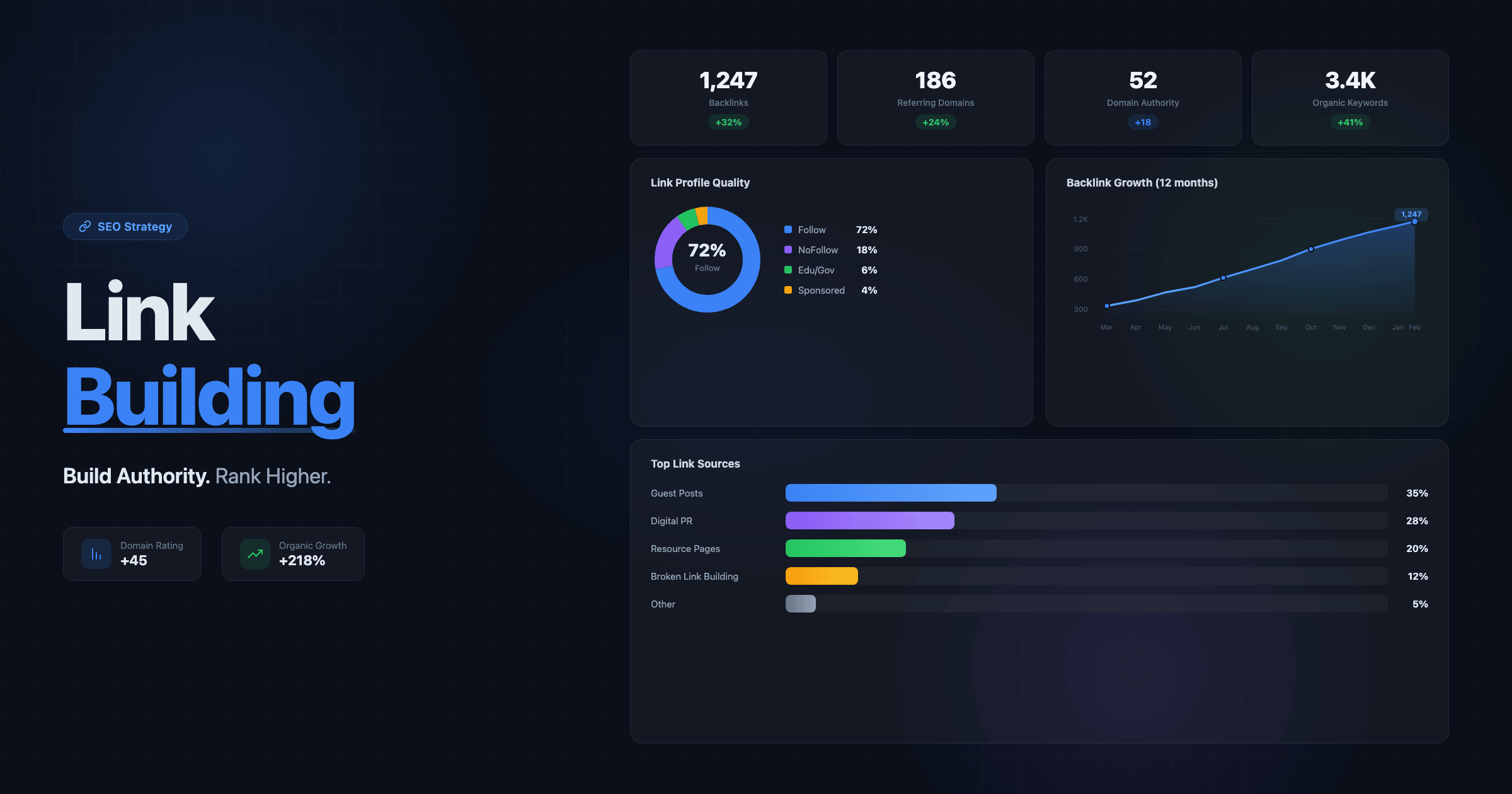
Backlinks remain one of Google’s top three ranking factors in 2026. A single high-quality link from an authoritative site can move your page from position 15 to position 5 — the difference between zero traffic and hundreds of monthly visitors. Yet most small businesses either ignore link building entirely or waste time on tactics that stopped working years ago.
The truth about link building in 2026: it’s not about quantity, it’s about relevance and authority. Ten links from respected industry sites will outperform 1,000 links from random directories. Google’s algorithms have become remarkably good at distinguishing earned links from manufactured ones — and they reward the former while penalizing the latter.
This guide covers link building strategies that actually work today — from guest posting and digital PR to resource page outreach and broken link building. No black-hat tricks, no paid link schemes, just sustainable methods that build your site’s authority over time.
Why Backlinks Still Matter in 2026
Despite years of speculation that backlinks would lose importance, Google’s own documentation and every major SEO study confirms: links remain a critical ranking signal. Here’s why they matter:
- Authority signal — each quality backlink is a vote of confidence from another website. Google uses these votes to determine which sites deserve to rank higher.
- Discovery mechanism — Google’s crawlers follow links to discover new pages. More backlinks mean faster indexing and more thorough crawling of your site.
- Referral traffic — good backlinks don’t just boost SEO. They send actual visitors to your site — often highly qualified ones who are already interested in your topic.
- Competitive moat — a strong backlink profile is one of the hardest things for competitors to replicate. Unlike on-page SEO changes, which competitors can copy in days, building genuine backlinks takes months or years.
The key shift in 2026: Google now evaluates link quality more aggressively than ever. Domain authority of the linking site, topical relevance of the linking page, placement within the content (editorial vs. footer), and anchor text naturalness all factor into how much value a link passes. This is why your overall website promotion strategy must include quality link building as a core component.
Link Building Fundamentals: What Makes a Good Backlink
Before diving into strategies, understand what separates a valuable backlink from a worthless (or harmful) one:
High-Value Link Characteristics
- Relevant domain — a link from a marketing blog to your marketing agency’s site is more valuable than a link from a cooking blog. Google assesses topical relevance.
- High domain authority — links from established, trusted sites (DA 50+) carry significantly more weight than links from new or low-quality sites.
- Editorial placement — links placed naturally within article content are worth more than sidebar links, footer links, or author bio links.
- Dofollow attribute — dofollow links pass link equity (ranking power). Nofollow links are still valuable for traffic and brand exposure but have less direct SEO impact.
- Natural anchor text — the clickable text should be varied and natural. Over-optimized anchor text (exact-match keywords every time) is a spam signal.
Links to Avoid
- Paid links without disclosure — buying links that pass PageRank violates Google’s guidelines. If caught, you risk a manual penalty that tanks your entire site’s rankings.
- Link farms and PBNs — private blog networks and sites that exist solely to sell links. Google identifies and devalues these systematically.
- Low-quality directory submissions — submitting to hundreds of random web directories is a 2010 tactic that does more harm than good today.
- Comment spam — dropping links in blog comments, forums, or social media without adding value. These are typically nofollow and flagged as spam.
- Reciprocal link exchanges — “I’ll link to you if you link to me” at scale. Google explicitly warns against excessive link exchanges.
Strategy 1: Guest Posting (Done Right)
Guest posting remains the most reliable link building strategy when done with quality in mind. The approach: write genuinely valuable content for relevant industry publications, earning a contextual backlink in return.
How to Find Guest Post Opportunities
- Google search operators:
"write for us" + your industry,"guest post" + your niche,"contributor guidelines" + your topic - Analyze competitor backlinks using free tools (Ahrefs Webmaster Tools, Moz Link Explorer). See where your competitors guest post — those sites likely accept contributions in your niche too.
- Industry newsletters and publications you already read — if you consume their content, you understand their audience well enough to contribute.
- LinkedIn networking — connect with editors and content managers at relevant publications.
Guest Posting Best Practices
- Pitch unique angles — editors reject generic pitches. Propose specific, data-backed, or experience-driven topics that their audience hasn’t seen before.
- Write your best work — guest posts should be at least as good as content on your own blog. Half-hearted articles damage your reputation and rarely get published.
- Link naturally — include 1-2 links to your site within the content where they genuinely add value for the reader. Don’t force links to your service pages — link to helpful resources, guides, or case studies instead.
- Build relationships — guest posting works best as an ongoing relationship with publications, not a one-time transaction. Regular contributors get better placement and more editorial freedom.
Strategy 2: Digital PR and Linkable Assets
Digital PR is the modern evolution of link building: create something newsworthy or genuinely useful, then promote it to journalists, bloggers, and industry publications. This earns high-authority editorial links that are nearly impossible to replicate.
Types of Linkable Assets
- Original research and data — survey your customers, analyze industry data, or compile statistics that don’t exist elsewhere. Journalists and bloggers constantly need data to cite.
- Comprehensive guides — the definitive resource on a topic in your industry. If your guide is genuinely the best on the web, other sites will reference and link to it naturally. Our SEO audit checklist is an example of this approach.
- Free tools and calculators — interactive tools that solve a specific problem for your audience. These attract links because people reference tools they find useful.
- Infographics and visual data — well-designed visual content that presents complex information in a digestible format. Still effective when the underlying data is original and valuable.
Promoting Your Assets
Creating great content isn’t enough — you need to actively promote it. Send personalized outreach emails to journalists and bloggers who cover your topic. Share on social media with a targeted strategy. Submit to relevant industry newsletters. The promotion effort should match or exceed the creation effort.
Strategy 3: Resource Page Link Building
Many websites maintain resource pages — curated lists of useful links on a specific topic. If you have relevant content, getting included on these pages is one of the highest-ROI link building tactics available.
How to find resource pages: Use Google operators like "useful resources" + your topic, "recommended links" + your industry, or intitle:"resources" + your keyword. Universities, government sites, and industry associations often maintain resource pages with high domain authority.
How to get included: Email the page owner with a brief, personalized message explaining why your resource would be valuable to their audience. Reference specific content on their page to show you’ve actually reviewed it. Keep the email under 150 words. Success rates are typically 5-15%, so volume matters — send 50-100 outreach emails to generate 5-10 quality links.
Strategy 4: Broken Link Building
Broken link building turns dead links on other websites into opportunities for your site. The approach: find resource pages or articles in your niche that link to pages that no longer exist (404 errors), create equivalent or better content on your site, then reach out to the linking site suggesting your content as a replacement.
Why it works: You’re helping the website owner fix a problem (broken link that hurts their user experience) while earning a backlink. It’s a genuine win-win.
How to execute: Use free tools like Check My Links (Chrome extension) to scan resource pages for broken links. When you find one, check the Wayback Machine to see what content used to exist at that URL. Create similar (but better) content on your site. Then email the webmaster, pointing out the broken link and suggesting your resource as a replacement.
Strategy 5: Building Links Through Relationships
The most sustainable link building happens through genuine business relationships — not cold outreach. Here are relationship-based approaches:
- Partner and vendor links — your business partners, suppliers, and complementary service providers often have “partners” or “clients” pages. Ask to be featured with a link.
- Client testimonials — offer to write testimonials for tools and services you use. Many companies publish customer testimonials with a link back to the customer’s site.
- Industry associations — join relevant industry groups, chambers of commerce, or professional organizations. Membership usually includes a directory listing with a backlink.
- Local business networks — for businesses serving a local market, local SEO and local link building go hand in hand. Local news sites, community organizations, and event sponsorships all provide quality local backlinks.
- Expert roundups and interviews — participate in industry expert roundups, podcast interviews, or Q&A features. These typically include a bio link back to your site.
Link Building Mistakes That Can Hurt Your Rankings
- Prioritizing quantity over quality — 100 low-quality links can actually hurt your rankings. Google’s Penguin algorithm specifically targets manipulative link patterns. Focus on earning fewer, better links.
- Over-optimized anchor text — if 80% of your backlinks use the exact same keyword as anchor text, Google sees this as manipulation. Natural link profiles have diverse anchors: brand name, URL, generic phrases (“click here,” “this article”), and varied keyword phrases.
- Ignoring link velocity — gaining 500 backlinks in a week then zero for three months looks unnatural. Consistent, steady link acquisition over time appears organic to Google.
- Not monitoring your backlink profile — competitors or spammers can create toxic backlinks pointing to your site (negative SEO). Monitor your profile monthly using Google Search Console’s Links report and disavow harmful links if necessary.
- Building links to your homepage only — distribute links across your key pages: service pages, important blog posts, and landing pages. A natural link profile has links pointing to many different pages, not just the homepage.
- Neglecting the foundation — link building on a site with technical problems is like pouring water into a leaky bucket. Fix on-page SEO, site speed, and mobile experience first. Run an SEO audit before investing heavily in links.
How to Measure Link Building Success
Track these metrics monthly to measure the impact of your link building efforts:
- Number of referring domains — more important than total backlinks. One domain linking to you 50 times counts less than 50 different domains linking once each.
- Domain authority / domain rating — track your site’s overall authority score (Moz DA or Ahrefs DR). This should trend upward as you acquire quality links.
- Organic keyword rankings — the ultimate metric. Are your target keywords moving up? Use Google Search Console to track positions.
- Organic traffic growth — more rankings = more traffic. Track in GA4 alongside your link building timeline to correlate efforts with results.
- Referral traffic — quality backlinks also send direct visitors. Check GA4’s referral traffic report to see which backlinks drive actual visitors.
Set realistic expectations: link building results typically take 2-4 months to materialize in rankings. A link acquired today won’t move your rankings tomorrow — but consistently building quality links over 6-12 months creates a compounding effect that’s hard for competitors to match.
A Practical Link Building Plan for Small Business
Here’s a manageable monthly link building routine for a small business:
- Week 1: Identify 10-15 guest post opportunities in your niche. Send personalized pitches to 5 publications.
- Week 2: Research 20 resource pages relevant to your content. Send outreach emails requesting inclusion.
- Week 3: Audit competitor backlinks. Identify 5 links you could replicate through better content or outreach.
- Week 4: Create or update one linkable asset (guide, tool, data piece). Promote it to your existing network and 10-15 targeted contacts.
This schedule requires roughly 4-6 hours per month and, when executed consistently, should yield 3-8 quality backlinks monthly. Combined with strong content marketing, this builds a powerful organic growth engine.
How EffectLab Approaches Link Building
We build websites designed to attract links naturally. Clean architecture, fast loading, mobile-first design, and compelling content create a foundation that earns links organically. Our clients’ sites are built with SEO best practices from the ground up — proper schema markup, optimized URL structures, and high-conversion page elements that make every link more valuable by converting the traffic it sends.
Need a website that search engines and other sites want to link to? Get in touch — we’ll review your current site and show you how technical improvements and content strategy can accelerate your link building results.
Conclusion
Link building in 2026 is about earning trust, not gaming algorithms. The strategies that work — guest posting, digital PR, resource pages, broken link building, and relationship-based outreach — all share one thing: they create genuine value for the linking site.
Start with the low-hanging fruit: industry associations, partner pages, and guest posts for publications you already read. Build one linkable asset per month. Send 20-30 outreach emails per week. Track your referring domains and keyword rankings monthly.
The businesses that win at SEO in 2026 aren’t the ones with the biggest link building budget — they’re the ones who build links consistently, focus on quality over quantity, and combine link building with solid on-page SEO and great content. Start today, be patient, and the compound results will follow.