
SEO on Autopilot: What You Can Automate in 2026 (and What You Can't)

Every business owner who has ever tried to do SEO seriously runs into the same wall. Not the algorithms, not the competition — the rhythm. One good article a month does nothing. Ten good articles, published consistently over a quarter, change the picture entirely. But between clients, invoices and everything else that actually runs the business, nobody has time to research keywords on a Tuesday night.
That gap is why “SEO automation” went from a dirty phrase to a serious category in 2026. Five years ago automated SEO meant spun text and link farms — a fast way to get penalized. Today it means something different: research, drafting, optimization and publishing handled by software, with a human approving the output.
This article is an honest breakdown of what can genuinely be automated, what still needs a person, how the whole cycle works end to end, and how to evaluate a platform before you pay for one. We build websites and run SEO for clients — and we also built our own automation service, Seonix AI, because we got tired of doing the same six steps by hand on every project. So consider this both a guide and a look under our own hood.
Why SEO stopped being a one-time project
There was a time when you could optimize a site once — fix the titles, write twenty pages, build some links — and coast on that for two years. That era is over, for three concrete reasons.
Search results refresh constantly. Google re-evaluates pages continuously. An article that sat at position 4 for a year quietly drifts to 11 as competitors publish something newer and more thorough. Nobody emails you about it. You just stop getting traffic, and by the time you notice the decline in analytics, you’ve been invisible for two months.
AI answers now sit above the results. ChatGPT, Gemini, Perplexity and Google’s AI Overviews answer the question before the user reaches anyone’s website. The brands those systems cite get the customer. Everyone else becomes invisible — not penalized, just skipped. This is a different failure mode from a ranking drop: your page can still be number one and still lose the click, because the answer appeared above it. We covered the mechanics of this in detail in our guide to AEO and GEO optimization.
Volume became a ranking factor in practice. Not spam volume — topical coverage. A site with 60 well-structured articles on a subject reads as an authority to both Google and language models. A site with 6 does not. Getting from 6 to 60 by hand takes a year of someone’s evenings, and most businesses quietly give up somewhere around article 11.
What can actually be automated — and what can’t
This is where most articles on the topic get dishonest. Automation is not magic, and pretending otherwise is how people end up with 200 pages of useless content. Here is the real split.
Safe to automate
- Technical audits. Crawling for broken links, duplicate meta tags, missing alt attributes, sitemap errors. This is mechanical work that software does better and faster than a person, and it never gets bored on page 400.
- Keyword research. Pulling search volumes, clustering queries by intent, filtering out what you realistically cannot rank for.
- First drafts. A structured, factually grounded draft built around a specific query — with headings, an intro that answers the question, and an FAQ block.
- On-page optimization. Heading hierarchy, keyword placement, internal links, meta descriptions, schema markup. Rule-based work with clear pass/fail criteria.
- Publishing and scheduling. Pushing finished articles to the CMS on a calendar instead of whenever someone remembers.
- Monitoring and refreshing. Watching positions, spotting articles that slipped, flagging what needs a rewrite before the decline compounds.
- Translation into new markets. Producing content natively in several languages — the place where manual work collapses fastest.
Still needs a human
- Strategy. Which audience, which products, which markets matter this quarter. No tool knows your margins.
- Real expertise and first-hand data. Your prices, your process, your case studies, the mistake you made in 2023 that taught you something. This is exactly what makes content worth reading — and it has to come from you.
- Final approval. Someone who knows the business has to read the article before it goes live. Always.
- Brand judgment. Tone, positioning, what you will and won’t claim publicly.
- Relationships. Partnerships, guest posts, being quoted by a journalist. Software doesn’t have a network.
The practical takeaway: automation removes the repetitive 80% and gives you back the time to do the 20% that actually differentiates you. Anyone selling you the other 20% too is selling you trouble.
How an SEO autopilot works, step by step
Strip away the marketing language and every serious automation service runs the same six-stage loop. Understanding it helps you evaluate any tool you’re considering — including ours.
Stage 1 — Understand the business. The system crawls your site and builds a profile: what you sell, where you operate, who the customer is, what tone you use. Everything downstream depends on this being right. A tool that skips this step writes generic content that could belong to any company in your industry — and generic content is exactly what neither Google nor a language model has any reason to prefer over the thousand pages already covering the topic.
Stage 2 — Find the queries worth winning. Not the highest-volume keywords — the ones you can realistically reach given your current authority. A new site chasing “business insurance” wastes six months. The same site targeting “business insurance for freelance photographers” gets traffic in weeks, and those visitors convert better because the query matched their situation exactly.
Stage 3 — Write. A draft in your brand voice, structured around the query, with facts about your business woven in rather than generic filler.
Stage 4 — Score and refine. The draft gets checked against on-page criteria — structure, keyword usage, readability, internal links, schema — and rewritten until it passes. This is the step that separates a content generator from a real SEO service. A generator hands you text; a service hands you a page that meets a standard.
Stage 5 — Publish. Straight into WordPress, Ghost, Webflow, Shopify or Wix, on a schedule, with meta tags and a social cover already in place.
Stage 6 — Watch and repair. Positions get tracked, and articles that lose ground get rewritten. SEO content decays; without this stage you’re refilling a leaking bucket.
AI search raised the bar for how content is structured
Here’s a shift a lot of businesses haven’t adjusted to yet. Writing for Google and writing to be quoted by an AI engine are related, but not identical.
Google rewards depth and authority. Language models reward extractability — content they can lift a clean, self-contained answer from. In practice that means:
- A direct answer in the opening paragraph, not a three-paragraph wind-up. If the model has to read 400 words to find your point, it will quote someone shorter.
- Clear factual statements instead of hedging. “Assembly of a standard IKEA wardrobe takes 2–3 hours” can be quoted. “Assembly times may vary depending on many factors” cannot.
- FAQ blocks with real questions people ask, answered in full sentences that stand on their own.
- Structured data that states plainly what your business is, where it operates and what it sells.
- An
llms.txtfile mapping your important pages for AI crawlers, and crawler access that isn’t accidentally blocked in robots.txt.
None of this is exotic — it’s a checklist. Which is precisely why it’s a good candidate for automation: it’s the kind of consistent, unglamorous work humans skip when they’re busy. If you want the full picture on this, we wrote about how AI engines pick which local businesses to recommend.
How to choose an automation service: seven questions
The category filled up fast, and most of what’s marketed as “AI SEO” is a text generator with a subscription. Before paying for anything, get answers to these seven questions.
- Does it study my business, or just my keyword? If setup is one input field and no crawl, expect content that could belong to any competitor.
- Does it score articles against SEO criteria before publishing? Without a scoring loop you’re getting drafts, not optimized pages.
- Can I edit and approve everything? Any service that publishes without your sign-off is a liability, not a feature.
- Does it publish into my CMS directly? Copy-pasting 30 articles a month by hand cancels out the automation.
- Does it handle AI search, not just Google? Ask specifically about AI visibility tracking,
llms.txtand answer-shaped structure. - Does it track what happens after publishing? Search Console and GA4 integration, and a refresh mechanism for decaying articles.
- What does it cost when I scale? Per-article pricing looks cheap at five articles and painful at fifty.
Seonix AI: the service we built
We ran the six stages above manually for client projects for a long time. It works, and it’s slow. So we built Seonix AI — a subscription service that runs the entire loop on autopilot: it studies your business, finds the queries your customers actually search, writes the articles, optimizes them, and publishes them to your site on schedule.
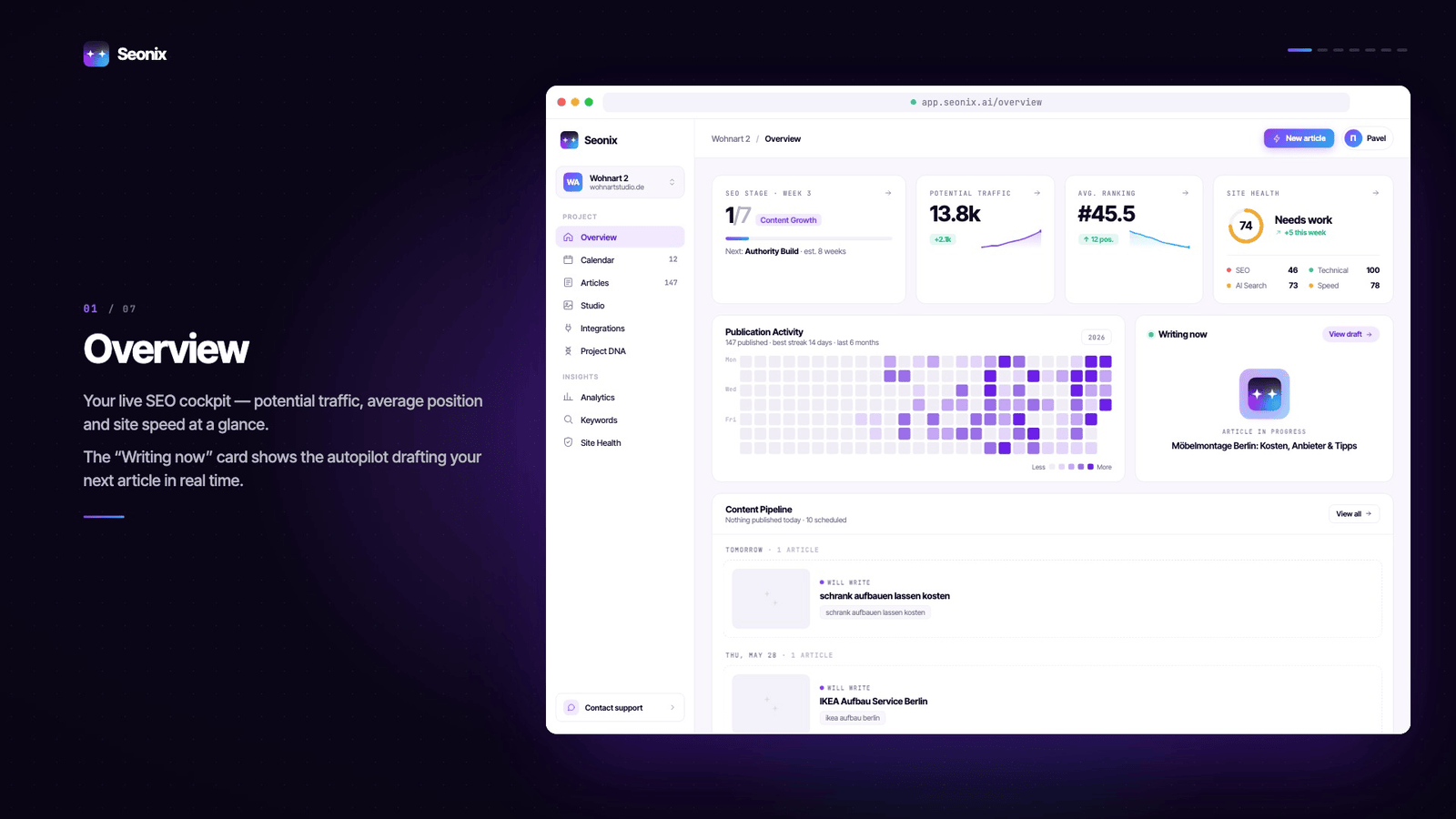
Inside there are 14 modules, and every one of them runs automatically on every project — no setup, no checklists. Eight cover traditional SEO:
- Technical SEO audit — crawls the site the way Google does and returns a prioritized fix list.
- Keyword research — finds the queries you can actually win, with real volumes.
- SEO content writing — publish-ready articles in your brand voice, with images.
- On-page optimization — scores and refines every article until it passes.
- Schema and rich results — structured data for articles, FAQs and your business profile.
- Meta tags and covers — titles, descriptions and social previews built to earn the click.
- Search Console and GA4 — live ranking and traffic reporting.
- Site speed — image optimization, critical CSS and caching for WordPress.
The other six exist specifically because search moved into AI answers:
- AI visibility tracking — checks whether ChatGPT and Gemini mention your brand when customers ask, and tracks how that changes.
- AI-ready content — structures articles the way AI engines quote: direct answers, FAQ blocks, clear facts.
- AI crawler access — keeps the site readable for AI engines, including an
llms.txtmap. - Brand knowledge profile — teaches search and AI engines who you are and why you can be trusted.
- Competitor analysis — finds who wins your target queries today and where the gaps are.
- Content refresh — rewrites articles that lose positions until the score recovers.
The part we care most about is the scoring loop. Every article is graded against strict on-page criteria before it can be published, and rewritten until it passes. You see the score live and can push it higher — or rewrite anything by hand — before it goes out.
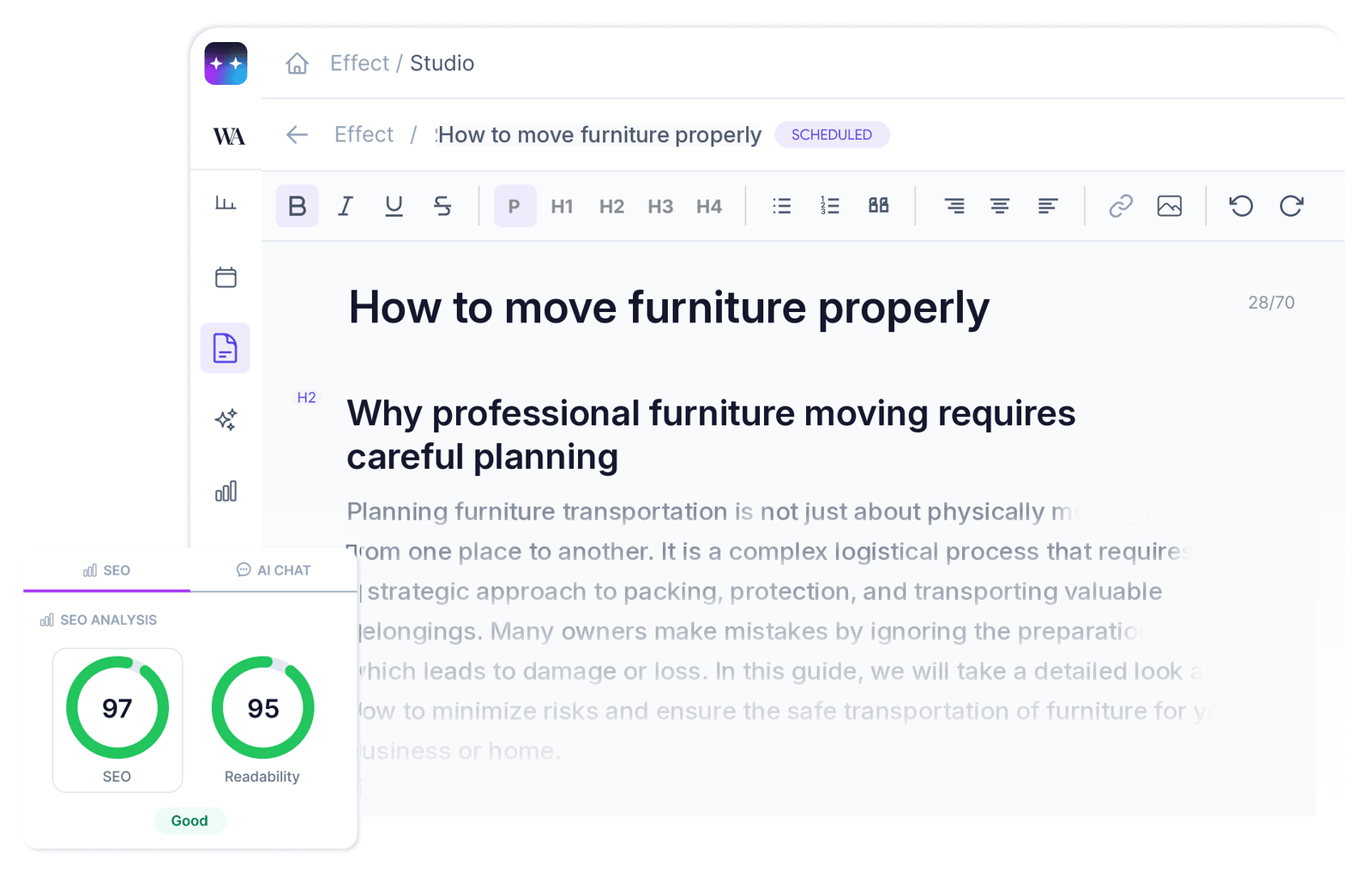
On the practical side: it connects to WordPress, Ghost, Webflow, Shopify and Wix, or to anything else through a custom API. It writes in 50+ languages natively rather than translating, which matters if you sell across borders. Pricing starts free for a full site audit, and the paid plan begins at $49 per month for a single site with 30 articles — against the $1,000+ monthly retainer a typical SEO agency quotes.
What this looks like on real sites
Two of the reference sites Seonix AI lists publicly are projects we built ourselves, which is convenient — we know exactly what went into them.
TechnoVector is a B2B distributor of heavy equipment carrying 140+ products from 11 international brands. Its customers don’t buy online — they research first and then send an inquiry, which makes informational queries the whole ballgame. It currently ranks in the top 6 for a Ukrainian query about how to choose a mini loader.
WohnArt Studio is a furniture assembly service in Berlin competing for local queries across 20+ districts — a niche where every competitor is chasing the same handful of phrases. It sits in the top 7 for “möbelmontage berlin”. Positions are as of July 2026 and search results shift daily, so treat them as a snapshot rather than a promise.
Neither is a large brand with a content team. Both are ordinary small businesses in competitive local niches, which is exactly the point: consistency is available to companies that can’t afford a retainer.
Five mistakes that ruin automated SEO
We’ve seen each of these sink a project. They’re all avoidable.
1. Publishing without reading. The single most expensive mistake. Automation makes it trivially easy to put 30 articles live without anyone checking whether the prices, claims and product names are correct. One wrong number in an article about your own services costs more trust than ten good articles build.
2. Chasing volume instead of coverage. Forty articles on slight variations of the same query compete with each other and cover nothing new. Better: forty articles that map the whole topic, each answering a distinct question.
3. Ignoring the site underneath. Content sits on a foundation. If pages load in eight seconds, the structure is confusing or the offer is unclear, more articles just bring more people to a bad experience.
4. Never adding first-hand material. The generic 80% is what automation gives you. If you never add your own numbers, screenshots and cases on top, your content is interchangeable with every competitor using the same category of tool.
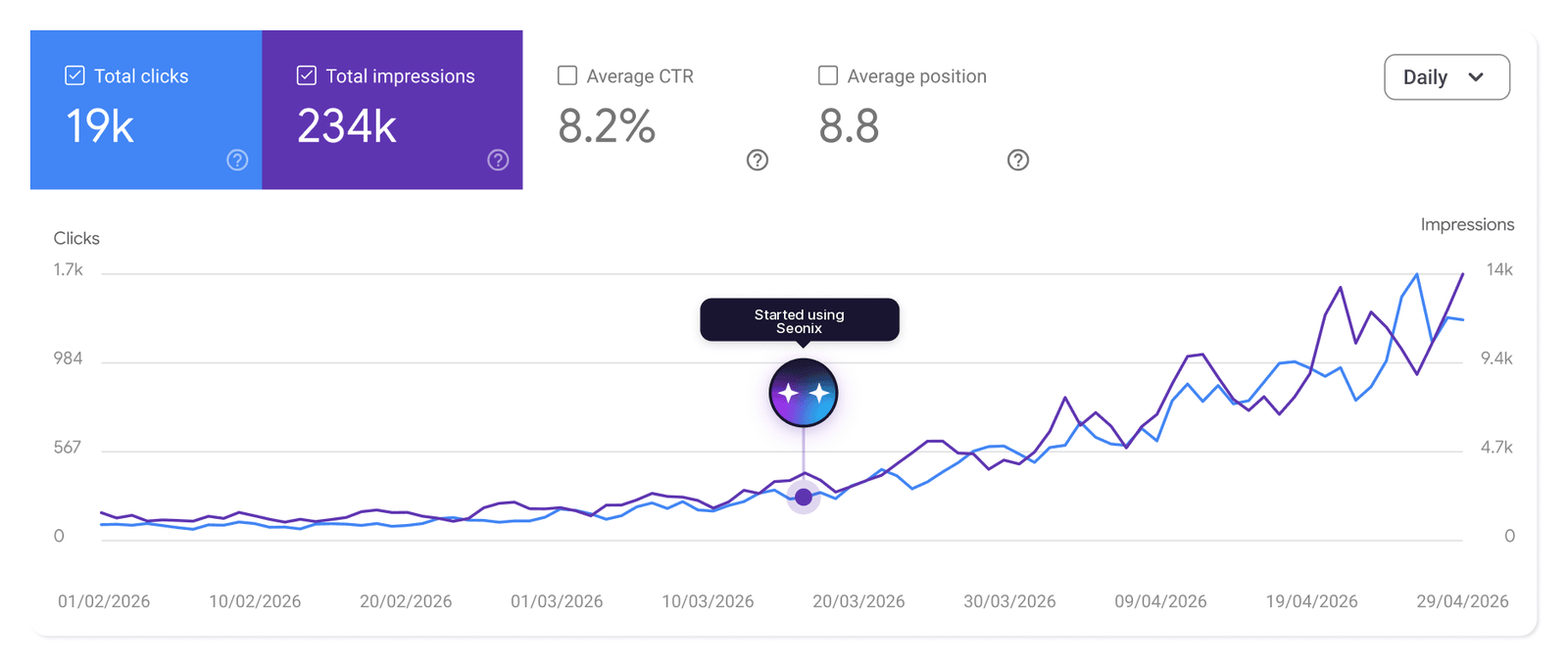
5. Quitting at week six. SEO compounds. Most businesses stop right before the curve turns upward, then conclude the approach doesn’t work.
Who this fits — and who should skip it
We’d rather you not waste money, so here’s the honest version.
Automation makes sense if you have a real business with a clear audience, you know your product, and the bottleneck is simply that nobody has time to publish consistently. It also fits multi-language markets — producing content natively in several languages is where manual work collapses fastest. And it fits anyone who has been quoted $1,000+ a month by an agency for four articles.
Skip it if your site has fundamental problems automation can’t fix — a broken structure, no clear offer, a page that takes eight seconds to load. Content won’t rescue a site people bounce off. Fix the foundation first; that’s a redesign conversation, not a content one. Skip it too if your business genuinely doesn’t sell through search — some don’t, and that’s fine.
And a warning worth stating plainly: publishing unreviewed AI output at volume is a real way to damage a site. Google’s guidance targets content produced primarily to manipulate rankings rather than help people. The difference isn’t whether a machine helped write it — it’s whether anyone made sure it was useful and true before it went live. Keep a human in the loop.
A checklist to start
- Audit what you have. Technical errors, thin pages, slow loading. Fix the blockers before adding content.
- Define the audience narrowly. “Small business” is not an audience. “Dental clinics in Lviv with 2–5 chairs” is.
- Build a query list you can actually win. Long-tail first; head terms come later, once you have authority.
- Commit to a cadence. Two articles a week beats ten in one burst followed by silence.
- Structure for both audiences. Depth for Google, extractable answers and FAQ blocks for AI engines.
- Review before publishing. Every article. Check facts, numbers and claims about your business.
- Add something only you have. A price, a photo, a case, a number from your own data.
- Measure after 8 weeks, not 8 days. Track impressions and average position first — clicks follow.
- Refresh what slips. Rewriting a decaying article usually beats writing a new one.
The bottom line
SEO in 2026 rewards consistency more than brilliance. The businesses winning organic traffic aren’t the ones with the cleverest strategy — they’re the ones that publish useful, well-structured content every week while their competitors mean to get around to it.
Automation is simply how a small team sustains that pace without hiring an agency or losing their evenings. It doesn’t replace knowing your business. It replaces the six repetitive steps between knowing your business and having an article live on your site — and in a search landscape where AI answers increasingly decide who gets found, being the brand that publishes consistently is what puts you in the answer.
Want to see where you stand first? Seonix AI runs a free AI-visibility analysis of your site — no card required — and shows which queries you’re losing and whether AI engines mention you at all. If you’d rather have people handle it, talk to us — we build the sites and run the SEO behind them.