
Content Marketing for Small Business: Strategy That Actually Works
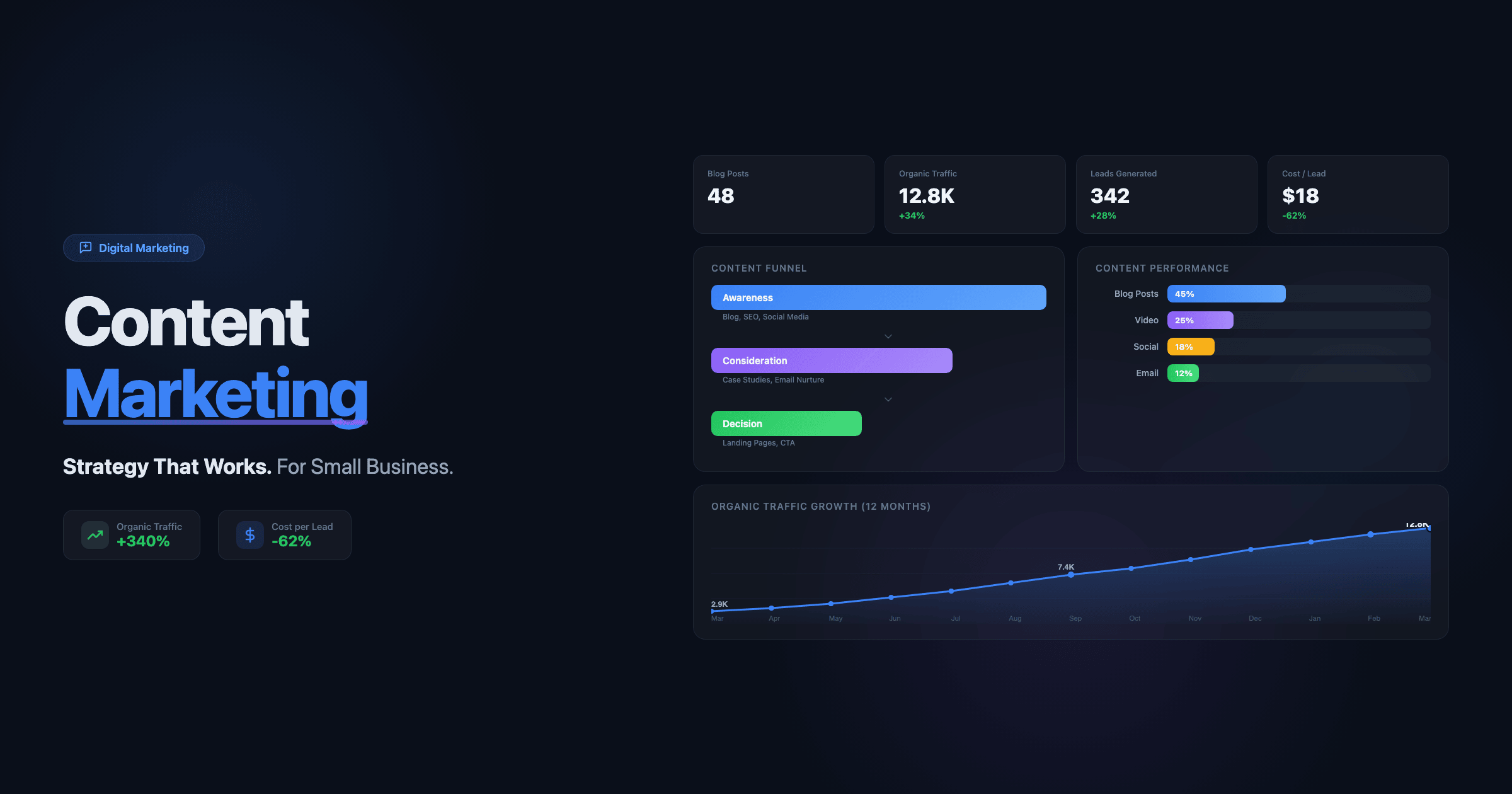
Most small businesses approach marketing backwards. They spend thousands on ads to rent attention for a day, while ignoring the one strategy that builds a compounding asset over time: content marketing. A blog post you write today can generate leads for years. An ad stops working the moment you stop paying.
But content marketing for small businesses isn’t about publishing three blog posts a week or going viral on social media. It’s about creating the right content for the right audience at the right stage of their buying journey — consistently, strategically, and without burning out a two-person team.
This guide covers how small businesses can build a content marketing strategy that actually drives revenue — not just traffic. We’ll cover what to create, where to publish, how to measure results, and how to do it all with limited resources.
Why Content Marketing Works for Small Business
Content marketing costs 62% less than traditional marketing while generating 3x more leads. But the real advantage for small businesses isn’t cost — it’s compounding returns. Unlike paid ads where results stop when spending stops, content builds organic visibility that grows over time.
Here’s what content marketing does that advertising can’t:
- Builds trust before the sales conversation — when a potential customer reads your helpful article, they already see you as an expert by the time they contact you. Cold outreach can’t replicate this.
- Captures demand at every stage — from someone Googling “how to fix X” (awareness) to “best company for X in my city” (decision). Ads typically only capture the bottom of the funnel.
- Creates a moat competitors can’t easily copy — 50 well-written articles targeting your niche keywords take months or years to replicate. A competitor can copy your ad in minutes.
- Reduces customer acquisition cost over time — month 1, your blog might generate 5 leads. By month 12, those same articles (plus new ones) might generate 50. Your cost per lead drops every month.
The companies that dominate organic search in any industry are the ones that started creating content consistently — not the ones that started with the biggest budget. This is where a solid website promotion strategy intersects with content marketing.
The Content Marketing Funnel: What to Create and When
Not all content is equal. A common mistake is creating only bottom-of-funnel content (“buy our service”) or only top-of-funnel content (“interesting facts about our industry”). You need content for every stage:
Top of Funnel: Awareness
Goal: Attract people who have a problem but don’t know you yet.
Content types: Blog posts answering common questions, how-to guides, industry trend articles, educational content. These target informational search queries — the “how to,” “what is,” “why does” questions your potential customers type into Google.
Example: A web development agency (like us) writing about common website mistakes or how to run an SEO audit. The reader isn’t looking for a web agency — they’re looking for answers. But they discover your expertise in the process.
Volume: This should be 60-70% of your content. It drives the most traffic and fills the top of your funnel.
Middle of Funnel: Consideration
Goal: Help people evaluating solutions understand why your approach is right.
Content types: Comparison articles, case studies, detailed guides on specific solutions, webinars, email sequences. These target people who know they have a problem and are actively researching solutions.
Example: An article comparing no-code vs custom development helps readers understand tradeoffs — and positions you as the expert who understands both options.
Volume: 20-30% of your content. Lower traffic but higher conversion intent.
Bottom of Funnel: Decision
Goal: Convert interested prospects into customers.
Content types: Landing pages, service pages, pricing guides, free consultations, ROI calculators. These are designed for people who are ready to buy and need a final push — strong CTAs, trust signals, and high-conversion page elements.
Volume: 10% of your content. Few pieces, but they must be extremely well-crafted.
Building Your Content Strategy: A Practical Framework
Step 1: Define Your Audience (Be Specific)
Don’t write for “everyone.” Define 2-3 specific audience segments. For each, answer: What is their biggest problem? What do they Google when that problem keeps them up at night? What objections do they have before buying?
A web development agency’s audience might be: (1) small business owners who need their first website, (2) marketing managers whose current site isn’t converting, (3) e-commerce owners looking to scale. Each segment needs different content.
Step 2: Do Keyword Research (But Think Topics, Not Keywords)
Use free tools — Google Search Console (if you have existing traffic), Google’s “People also ask” boxes, AnswerThePublic, or Ahrefs free webmaster tools. Look for questions your audience asks and topics with reasonable search volume.
Group related keywords into topic clusters. Instead of writing 10 thin articles about similar keywords, write one comprehensive guide that covers the topic thoroughly. This is how modern SEO works — depth beats quantity. A properly structured site with topic clusters also improves your overall SEO performance.
Step 3: Create a Realistic Content Calendar
The biggest content marketing mistake is starting with an ambitious schedule and burning out by month 2. For small businesses, here’s a realistic starting point:
- 2 blog posts per month — long-form (1,500-2,500 words), well-researched, SEO-optimized
- 1 email newsletter per month — repurpose blog content, add exclusive insights
- Social media sharing — share each blog post across your social channels 3-4 times (different angles each time)
- 1 case study per quarter — showcase real results from real clients
That’s roughly 6-8 hours of content work per month — manageable for a small team. Consistency beats volume. Two great articles per month will outperform ten mediocre ones.
Step 4: Write Content That Ranks and Converts
Every piece of content should follow these principles:
- Answer the search intent — if someone Googles “how to improve website speed,” they want actionable steps, not a 500-word intro about why speed matters.
- Structure for scanning — use H2/H3 headings, bullet points, bold key takeaways. Most readers scan before they read.
- Include a clear next step — every article should guide the reader somewhere: another article (internal link), your service page, or a contact form.
- Be specific, not generic — “increase your conversion rate” is generic. “Add a sticky CTA bar to your pricing page — businesses that do this see 15-25% more form submissions” is specific and actionable.
- Use your own experience — generic advice is everywhere. What makes your content unique is real data, real examples, and real opinions from doing the work.
Content Types That Work Best for Small Business
Not all content formats deliver equal ROI. Here’s what works best when resources are limited:
- Long-form blog posts (1,500+ words) — the backbone of content marketing. They rank better in search, get more backlinks, and establish authority. Target one primary keyword and several related ones per post.
- How-to guides and tutorials — high search volume, high trust-building potential. People who learn from you are more likely to hire you.
- Listicles and checklists — easy to consume, highly shareable. “7 Signs Your Website Needs a Redesign” or “SEO Audit Checklist” formats consistently perform well.
- Case studies — the most powerful bottom-of-funnel content. Real results from real clients overcome objections better than any sales pitch.
- Comparison and “vs” articles — capture high-intent search traffic. People comparing options are close to a buying decision.
What to skip (for now): podcasts, video series, and daily social media content. These require significant ongoing investment and are better added once your blog foundation is solid.
Measuring Content Marketing ROI
Content marketing fails when businesses treat it as a branding exercise with unmeasurable results. Everything should tie back to business outcomes. Here’s what to track:
Leading Indicators (Monthly)
- Organic traffic growth — are more people finding you through search? Track in GA4.
- Keyword rankings — are your target keywords moving up? Track in Google Search Console.
- Engagement rate per article — are people actually reading or bouncing immediately?
- Email subscriber growth — is your content converting visitors into subscribers?
Lagging Indicators (Quarterly)
- Leads generated from content — how many contact form submissions, calls, or demo requests came from people who read your blog first?
- Content-attributed revenue — of those leads, how many became paying customers? What’s the revenue?
- Cost per lead from content vs. ads — compare your content marketing spend (time + tools) to your ad spend per lead. Content should win within 6-12 months.
- Customer acquisition cost trend — is your overall CAC decreasing as content compounds?
Set up proper conversion tracking in GA4 — without it, you’re guessing. Our website analytics guide walks through the exact setup process.
Common Content Marketing Mistakes
- Writing for search engines, not humans — keyword-stuffed, robotic content ranks poorly and converts worse. Google’s algorithms reward content that genuinely helps users.
- No distribution strategy — publishing a blog post and hoping people find it is not a strategy. Every post needs promotion: social media, email, relevant communities, internal linking.
- Inconsistency — publishing 8 articles in January, then nothing until April. Search engines and audiences both reward consistency. Two posts per month, every month, beats bursts of activity.
- Ignoring existing content — updating and improving old articles often delivers faster results than writing new ones. Check your analytics for declining posts and refresh them.
- No internal linking — every new article should link to 3-5 existing articles, and existing articles should be updated to link back. This builds topic authority and keeps readers on your site longer.
- Expecting instant results — content marketing is a 6-12 month investment before significant ROI. If you need leads tomorrow, run Google Ads. Content marketing is for sustainable growth.
Content Marketing + SEO: The Compound Effect
Content marketing and SEO aren’t separate strategies — they’re two sides of the same coin. Content gives SEO something to rank. SEO gives content an audience. Together, they create a compound growth engine:
- You publish a well-optimized article targeting a specific keyword.
- Google indexes and starts ranking it (usually positions 15-30 initially).
- As users engage with it, Google moves it higher.
- You build internal links from other articles, strengthening its authority.
- It reaches page 1 and starts generating consistent organic traffic.
- That traffic generates leads — some become customers.
- You use customer insights to create more targeted content.
- The cycle repeats, each article strengthening the others.
This is why businesses that invest in content marketing consistently for 12+ months see exponential rather than linear growth. The first 10 articles build the foundation. Articles 11-30 start compounding. After 50+ quality articles, you have an asset that generates leads while you sleep.
But this only works if your website’s technical foundation is solid. Slow loading speed, poor mobile experience, or hidden technical issues can undermine even the best content. Make sure your site passes a basic SEO audit before investing heavily in content.
How EffectLab Approaches Content Marketing
We practice what we preach. The blog you’re reading right now is part of our own content marketing strategy — every article targets specific keywords, addresses real questions from our audience, and links to our services naturally.
For clients, we help build content marketing foundations: technically optimized websites that rank well, proper analytics setup to measure content ROI, and strategic guidance on what topics to target. We also create landing pages and service pages designed to convert the traffic your content generates — using proven high-conversion elements.
Need help building a website that supports your content marketing strategy? Let’s talk — we’ll audit your current setup and identify the biggest opportunities for content-driven growth.
Conclusion
Content marketing isn’t complicated. It’s creating helpful content for your audience, optimizing it for search, distributing it consistently, and measuring what works. The hard part isn’t strategy — it’s execution. It’s publishing that 15th blog post when your first 14 haven’t gone viral yet.
But the businesses that push through that period are the ones that eventually dominate their niche in organic search. They spend less on ads, generate more qualified leads, and build a brand that customers trust before they ever pick up the phone.
Start small. Two articles per month. Measure everything. Improve based on data. In 12 months, you’ll have a content library that works for you 24/7 — and a cost per lead that makes paid advertising look expensive.